

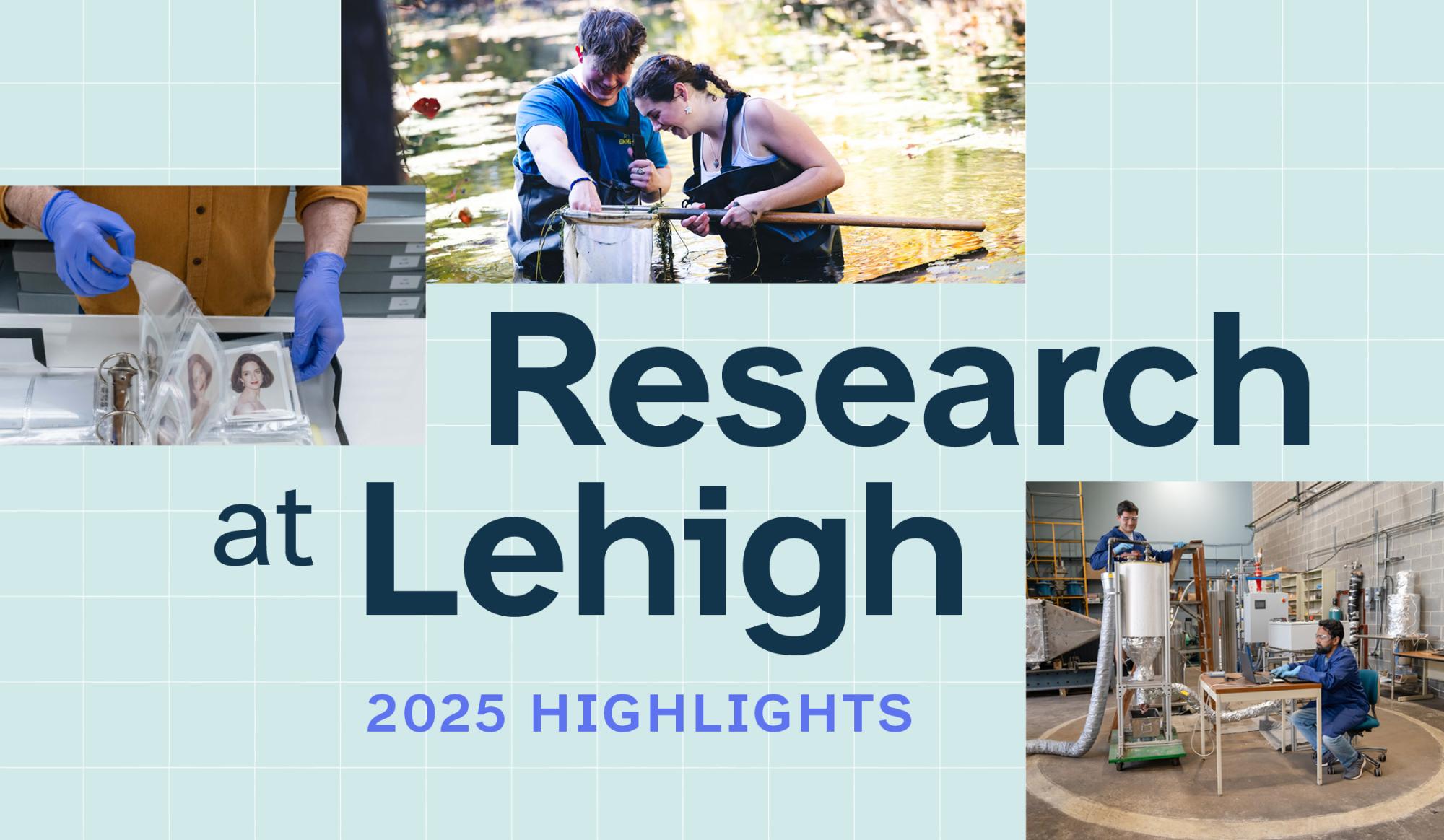
As 2025 comes to a close and we reflect on the university’s progress over the past year, below is a selection of standout research stories that capture the momentum of Lehigh’s scholarly achievements. This year brought the launch of innovative research centers, interdisciplinary breakthroughs, the milestone of an R1 designation, and collaborations that are translating science and technology into real-world solutions for communities, industries and global challenges.
Lehigh’s Research Highlights of 2025
Getting your Trinity Audio player ready...
Take a look back at some of the top research stories at the university in 2025.
Share This Story


Posted on
December 22, 2025
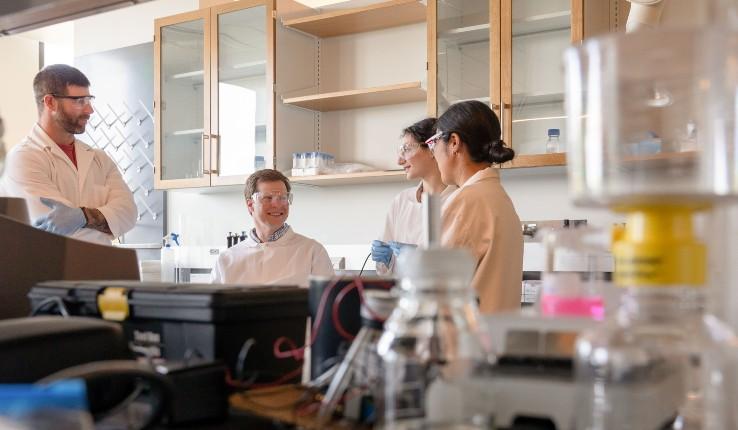
From center, Professor James Gilchrist, the Ruth H. and Sam Madrid Professor of Chemical and Biomolecular Engineering, Nazrin Hasanova '21 and Xuanhong Cheng, professor of bioengineering and materials science and engineering.
Lehigh Designated R1 Research University
Lehigh was designated an R1 university by the Carnegie Classification of Institutions of Higher Education in 2025. This denotes the highest levels of research activity and classifies Lehigh as a top-tier research university. As the only R1 school in the Lehigh Valley (and one of seven in Pennsylvania), this recognition helps to attract and retain top faculty and enhance opportunities for students.
Two New University Research Centers Established
Lehigh launched two new University Research Centers (URCs) in 2025: the Center for Community‑Driven Assistive Technologies (CDAT) and the Center for Advancing Community Electrification Solutions (ACES). CDAT explores existing and emerging assistive and adaptive technologies to improve mobility, daily living, education and more for people with physical, cognitive, sensory or developmental disabilities. ACES focuses on sustainable, efficient community-scale electrification, transforming how communities power buildings, transportation and water systems while promoting energy security, independence and lower costs. Together, the centers reflect Lehigh’s commitment to interdisciplinary research that addresses social, health and energy challenges.

Farrah Moazeni, assistant professor of civil and environmental engineering, and civil and environmental engineering student Maddie Burns ’27 work together on data center direct-to-chip cooling solutions.
Developing Energy-Efficient Solutions for AI Data Centers
Lehigh's Center for Advancing Community Electrification Solutions (ACES) is working to make AI data centers more energy- and water-efficient, addressing growing concerns about their heavy power and cooling demands.Researchers are exploring innovations such as direct-to-chip cooling, microgrids for managing interconnected AI data centers, waste heat recovery and demand-response models to reduce grid strain and resource use. Their work combines lab experiments, real-time data from Lehigh's computing facilities and interdisciplinary collaboration, potentially shaping how future AI infrastructure is built nationwide.
New Material Gives Copper Superalloy-like Strength
Researchers at Lehigh and the U.S. Army Research Laboratory developed a groundbreaking new nanostructured copper alloy (Cu‑Ta‑Li alloy) combining copper's conductivity with strength and thermal stability comparable to nickel‑based superalloys.The alloy holds its shape under extreme, long-term thermal exposure and mechanical stress and resists deformation near its melting point, which is promising for aerospace, defense and industrial heat‑intense applications. Martin Harmer, Alcoa Foundation Professor Emeritus of Materials Science and Engineering at Lehigh, co-authored the study, published in the journal Science.
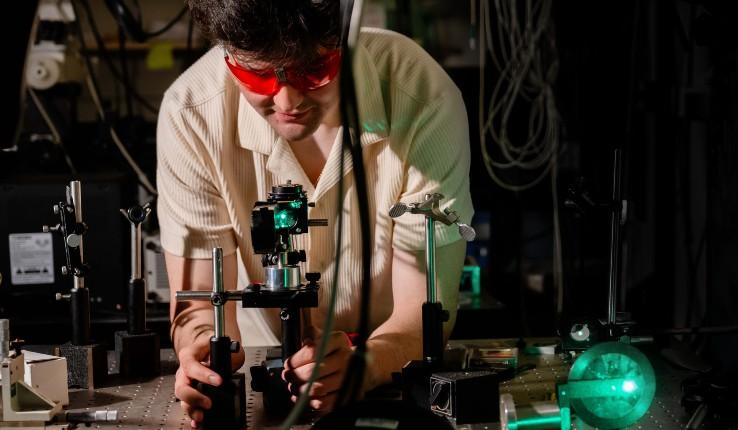
Saimonth Muñoz ’26, a 2025 Goldwater Scholar, conducts research on rubrene, an organic semiconductor that can transfer information through light.
Lehigh Student Earns Prestigious Goldwater Scholarship for Rubrene Research
Saimonth Muñoz ’26 was awarded a 2025 Goldwater Scholarship, one of only 441 recipients nationwide, for his research on rubrene, an organic semiconductor that transmits information via light.Muñoz, a double major in electrical engineering and physics, explores rubrene’s quantum properties under mentor Ivan Biaggio, professor and Joseph A. Waldschmitt Chair in Physics. The honor highlights Muñoz’s commitment to research and underscores Lehigh’s strength in fostering undergraduate innovation.
Lehigh, Rice Launch Consortium for Enhancing Resilience and Catastrophe Modeling
Lehigh and Rice University have launched a new research initiative, Consortium for Enhancing Resilience and Catastrophe Modeling (CERCat), to improve disaster‑risk modeling and community resilience. CERCat unites academic researchers, industry experts and public‑sector innovators to build more realistic, multihazard models that account for overlapping threats and to deploy tools like AI for faster post‑disaster damage assessment.With 18 interdisciplinary faculty across civil engineering, Earth sciences, statistics, mathematics, public policy, computer science and social sciences, plus students and industry partners, the consortium aims to translate cutting‑edge research into concrete applications.
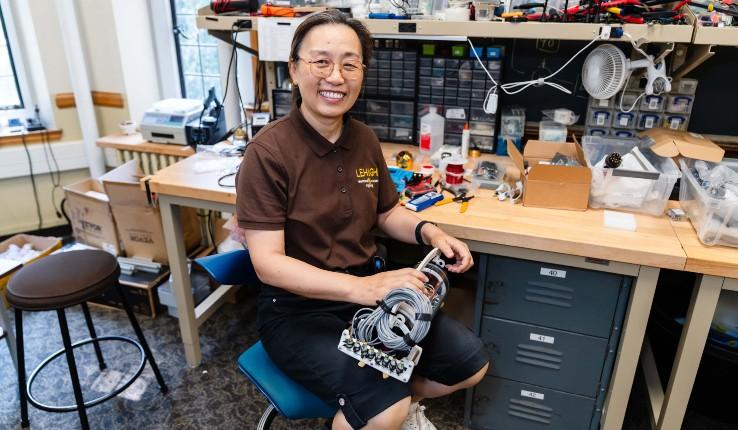
Yahong Rosa Zheng, professor of electrical and computer engineering, and her team conduct research to make underwater acoustic communication more reliable, safer for marine ecosystems and transmitted at a higher and faster data rate.
Pioneering Turbo‑Equalized Acoustic System to Improve Underwater Communication
Yahong Rosa Zheng, professor of electrical and computer engineering, and her team developed a high‑frequency acoustic system using “turbo equalization” that dramatically improves underwater communication speed and reliability. Their prototype sends multiple data streams simultaneously and untangles echo‑ and Doppler‑distorted signals in real time, enabling potential underwater video, image and data transmission. Their work has earned four U.S. patents and powered the launch of Zheng’s startup, Sea‑Gal Technologies, aimed at commercializing the technology for applications like marine research, infrastructure monitoring and military operations.
Report Shows Lehigh’s Research Positively Impacts Local Economy and Community
Released in July, Lehigh’s 2023–2024 Community and Economic Impact Report found that the university contributed $1.4 billion to the regional economy. Notably, the university’s research activities alone contributed $48.1 million, supporting innovation that led to 30 inventions, 35 patents and a license. Moreover, nearly $797 million came from startup and spin-off companies and manufacturers connected with the university, underscoring how academic research and entrepreneurship are directly fueling regional economic growth and job creation.

Elizabeth (Beth) A. Dolan, dean of Lehigh’s College of Health, said that the formal partnership Lehigh established with Good Shepherd Rehabilitation is a milestone for the College of Health and the university in expanding research impact in health and health care.
Lehigh, Good Shepherd Rehabilitation Partner to Advance Disability Health Equity
Lehigh established a partnership with Good Shepherd Rehabilitation in September, advancing the university’s commitment to health-focused collaboration, research and education. The partnership is grounded in a shared vision to improve the lives of people living with disability and represents Lehigh’s first formal partnership with a leading rehabilitation network. The bold university-wide partnership will drive innovation through joint faculty appointments, interdisciplinary research and more.
Lehigh Hosts Symposium to Highlight Work of Research Community
Lehigh celebrated its growing research enterprise at the 2025 Lehigh University Research Symposium. Faculty, staff and partners from academia, industry and government convened to hear faculty share fast‑paced “lightning talks” about their research spanning diverse fields from climate science to AI to community health, showcasing the depth and breadth of research conducted at Lehigh.
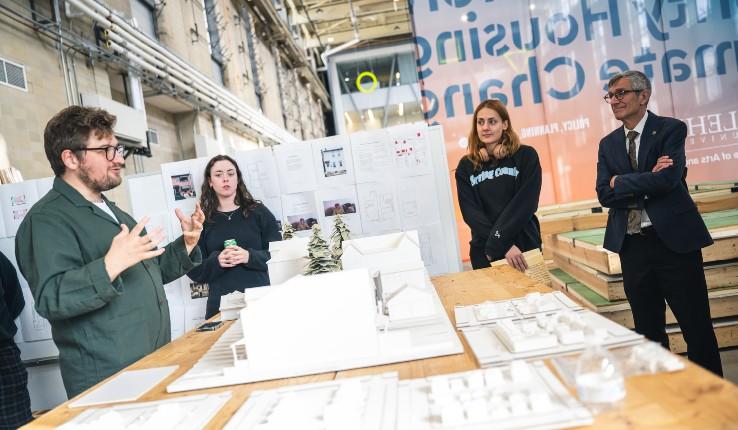
Wes Hiatt (far left), co-director of Small Cities Lab and assistant professor of architecture, discusses the Small Cities Lab with President Joseph J. Helble ’82 and others.
Inaugural Small Cities Lab Co-Lab Brings Together Researchers, Community Leaders
The Small Cities Lab at Lehigh held its inaugural “Co-Lab” in September, convening researchers and community leaders.The two-day event featured sessions, talks and workshops meant to shape a common definition of “small city,” surface community needs and help guide the Lab’s future priorities and research agenda. The event marked an important step in connecting academic insight with local stakeholders and laying groundwork for action-oriented solutions to challenges facing small cities.
Lehigh Convenes Experts to Tackle Challenges for AI Data Centers
Lehigh hosted a day-long Center for Advancing Community Electrification Solutions (ACES) Symposium in October, bringing together over 130 leaders from academia, industry and government to address energy and water challenges for AI data centers. The event featured keynote talks and panels on infrastructure needs, including power, water use and grid resiliency, as well as discussion of forming a university–industry consortium to build sustainable solutions.University leaders emphasized the urgency of rapid, interdisciplinary research and collaboration to meet future energy and sustainability demands.
Share This Story
Posted on
December 22, 2025