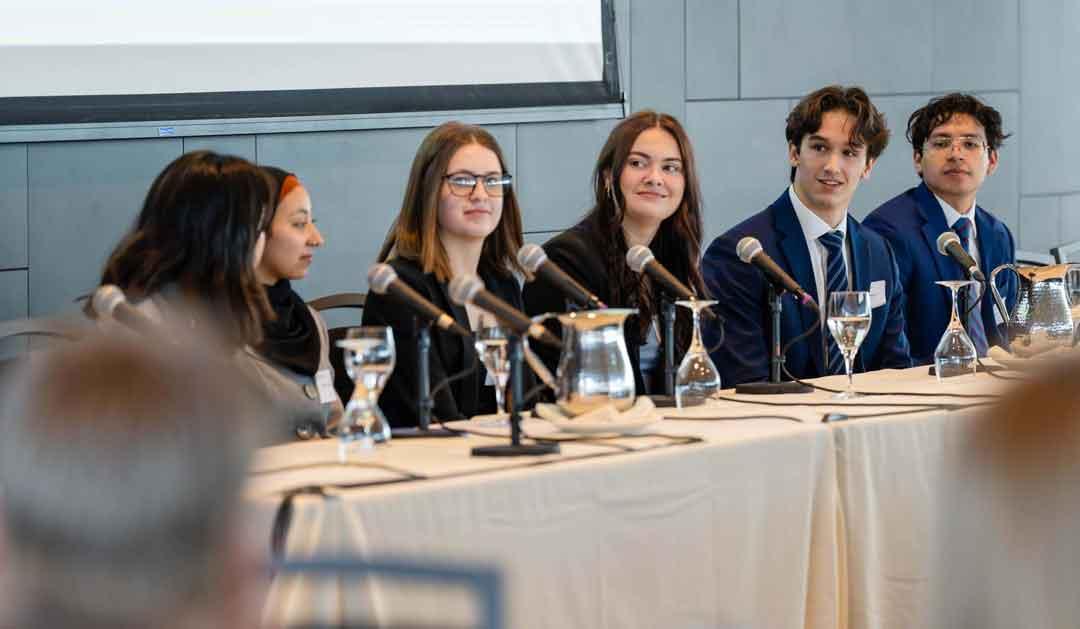
A panel of five young adults seated at a table with microphones, discussing an event.

One of five panels on the day, this panel featured eight students with a range of majors who shared how they use AI and emphasized the need for faculty to understand and adapt to students’ use of AI.

AI Dominates Conversation at Inclusive Excellence in Teaching Workshop

Getting your Trinity Audio player ready...

The all-day event held Jan. 15 at Lehigh’s Mountaintop Campus featured panels composed of business leaders, faculty and students.

Story by

Stephen Gross

Photography by

Christa Neu

President Joseph J. Helble ’82 spends a lot of his time traveling and meeting with those in the community, as well as alumni around the world.

A few topics, such as Lehigh’s Inspiring the Future Makers strategy and the university’s R1 status as a research institute, come up often. But in speaking at the Inclusive Excellence in Teaching, Student Success & Belonging Workshop Jan. 15 in the Iacocca Hall Wood Dining Room, he said something that finds its way into every single conversation is AI.

“How are our students using it?” Helble said he’s asked. “What are our students doing with it? How are they learning? Are the students learning from the faculty? Are the students teaching the faculty? How are the faculty engaging with these tools? How do we ensure academic integrity in the use of these tools? How do we use it to help improve our operations, our efficiency, our practices? And how do we make sure our students are prepared to use it ethically, thoughtfully, responsibly and accurately as a tool when they leave Lehigh and begin their working lives?”

Many, if not all, of those questions Helble mentioned were discussed and addressed at the all-day workshop, which followed the theme “Learning from Peers to Help Shape How We Move Forward in Advancing Student Success and Community of Belonging.” With more than 100 registered staff and faculty, and business leaders joining both in-person and via Zoom for panel presentations, AI was at the forefront of the conversation for much of the day.

“It really is an important collaborative set of discussions we want to have as we think about the importance of inclusive teaching for all of us here at Lehigh,” Helble said, kicking off the workshop.

After welcoming remarks from Terry-Ann Jones, deputy provost for Undergraduate Affairs, and Helble, the day featured five different panels, ranging from those composed of senior corporate executives, to faculty and current students.

Three professionals engaged in a discussion, with varying attire and expressions, indoors.

Sydney (O’Tapi) Gooden 18, vice president, J.P. Morgan Asset Management, converses with workshop attendees during a break. Gooden was a member of the first panel of the day.

The first of two student panels was held mid-morning, featuring eight students with a range of majors who shared how they use AI and emphasized the need for faculty to understand and adapt to students’ use of AI. Advised by Burak Eskici, teaching assistant professor, the panel took a live poll of those in attendance asking how they think students use AI before sharing data on how students actually use AI.

Then, with the use of a fictional undecided first-year student “Joe”, whose image was AI-generated, the panel walked through one evening on his Google Calendar.

“He knows that AI is changing the world around him,” Nathan Balderas ’27, an Industrial Systems Engineering and Integrated Business and Engineering Finance student, said. “And he wants to be ready to use AI, not only in the classroom and in his coursework, but also in the real world as he starts his professional development journey.”

“Joe’s” night consisted of studying, completing abstract architect homework, researching and writing a biology paper and applying for internships.

Throughout the presentation, the students stressed ethical ways students can use AI to assist their work—not do the work for them.

One example was when “Joe” began the process of writing a paper on bacteriophages. He had yet to figure out what journals might accept papers on his topic and who the target audience of those journals are. Megan Thomas ’27, a molecular biology, pre-med track student, displayed a ChatGPT prompt they created asking where “Joe” could target, what journals are accepting papers on this topic and the requirements for submission.

“This is not what someone is reading,” Thomas said. “This is a very, very early on step.”

Thomas said what might have taken “Joe” an hour on his own, took her 26 seconds.

“If we can start utilizing AI in this process for things like this, now he gets to spend that hour of time doing what you all care about, getting the work and doing the thinking and doing the analysis and putting his words on paper, because he now has the time,” Thomas said. “This is where research can be integrated with AI, not the final paper.”

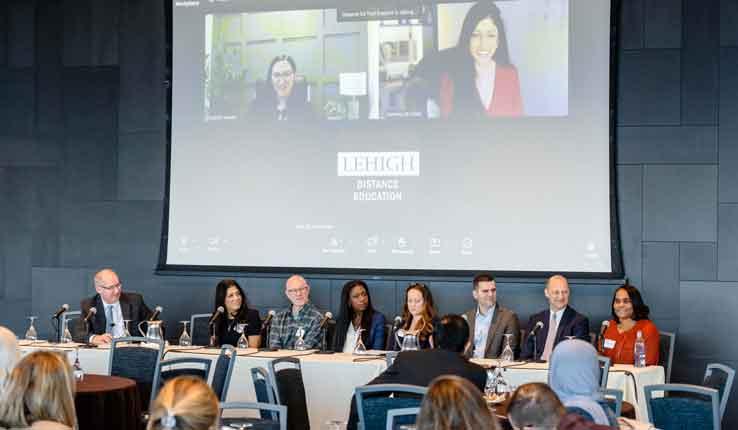
A panel discussion with eight speakers, including a video call participant in the background.

A panel composed of senior corporate executives, both in-person and on Zoom, was the first of five panels featured throughout the day.

In addition to ChatGPT, the exercise showcased numerous AI tools, including Notebook LM and Career Duck.

Before wrapping up their one-hour and fifteen-minute session, the students facilitated an interactive activity where each table received scenarios for a student and were asked how they believed that student would use AI and how they would want the student to use AI.

The panel also offered advice on how faculty can approach the use of AI with students. Zaki Kahn ’27, who is majoring in computer science and business and minoring in entrepreneurship, said the group’s biggest takeaway from their work was that faculty should teach students how to use AI while studying for their courses.

“My biggest advice is experiment with your course and really show the example to your students on how to actually use your course materials,” Kahn said. “I'm sure you've probably had a lot of students that come to your office hours that say, ‘I didn't do well in the last exam, how can I prepare for the next one?’ Utilizing these AI tools to help make this more efficient for your students is probably the best way, because we all want to see our students succeed, and the best way is by showing the example.”

Thomas said faculty needs to prepare for their students using AI because students will find a way regardless of what is outlined in the course.

“You have to recognize that AI is going to happen, and so the best thing that you can do is show them ways that they can actually use it effectively,” Thomas said. “So draw that line between ethical practices and effectiveness for the student.”

Thomas laid out another scenario of a first-year student navigating PubMed for the first time while writing a research paper. She referenced the earlier example of using ChatGPT to target journals, but explained there are many more ways to incorporate AI.

“Say you have a student who has never read a scientific publication before, has no idea what they're looking at. You can upload the figures from the paper. Ask it, ‘Can you explain to me what this is really showing me? I don't know what all these symbols mean.’ It makes it more easily digestible, it makes it easier to understand, and it accelerates the process for students, without sacrificing the intellect and the critical analysis that is required from this type of work.”

The panel immediately following, moderated by Dominic Packer, vice provost for educational innovation and assessment and senior advisor to the vice provost for research, featured seven faculty members, who responded directly to the student panel before them.

None may have been impacted by the student panel more than Vassie Ware, professor of molecular biology.

“I've been transformed because I am very skeptical of how it is that we can incorporate AI and not lose the concept of critical thinking,” Ware said. “I'm amazed that I could be transformed to the degree that I was today. … I mean, I'm still skeptical, but I am saying that I'm excited about the idea that the students brought forward.”

Others on the panel agreed with the students, at least to some degree, on the need to embrace AI.

“This is something that we will be dealing with, and I do recognize the need to incorporate at the most minimal level, language and syllabi and talk about proper uses and even demonstrate,” Matt Bush, professor of Spanish and Hispanic studies. I thought that was a very helpful idea to demonstrate to students proper use of mapping conversations, and so that would be something very important that I take from that panel.”

While acknowledging the need to adapt to AI in the classroom, and calling the student presentation “exceptional,” Bush said he’s also added more oral exams and in-class writing and encouraged other faculty members to do so.

“Particularly from a humanistic perspective, that that is one of the real things of value that we can offer at a university now, spaces where there are still, perhaps not technology-free, but dialog among students and dialog with their professors that allow us to really, for me, savor what is important in our university education.”

The day began with a panel, moderated by Nathan Urban, provost and senior vice president for academic affairs, featuring senior corporate executives, many of whom are Lehigh alumni, from a variety of companies, including Johnson & Johnson, Lumeris Company, J.P. Morgan Asset Management, KPMG and Bloomberg Company, as well as several others. After alums on the panel shared one thing from Lehigh that was most helpful to them in their careers, the discussion largely focused on AI use at their companies and how it’s integrated, along with advice for professors.

The workshop also featured an interactive table discussion as attendees brainstormed an action plan for their respective courses based on what they learned throughout the day and wrapped up with a networking reception.

Story by

Stephen Gross

Photography by

Christa Neu