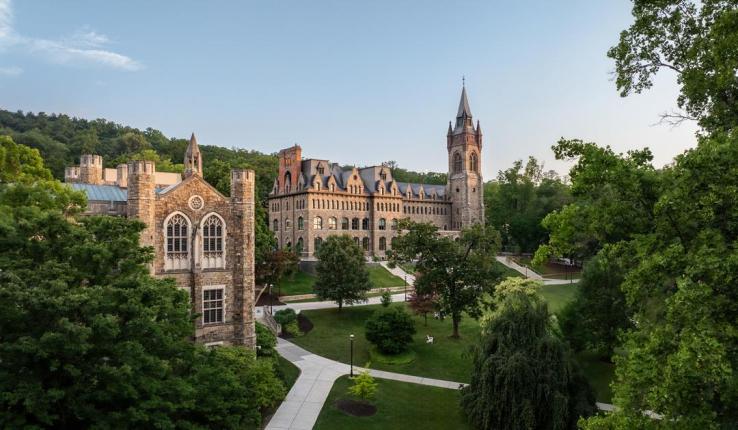
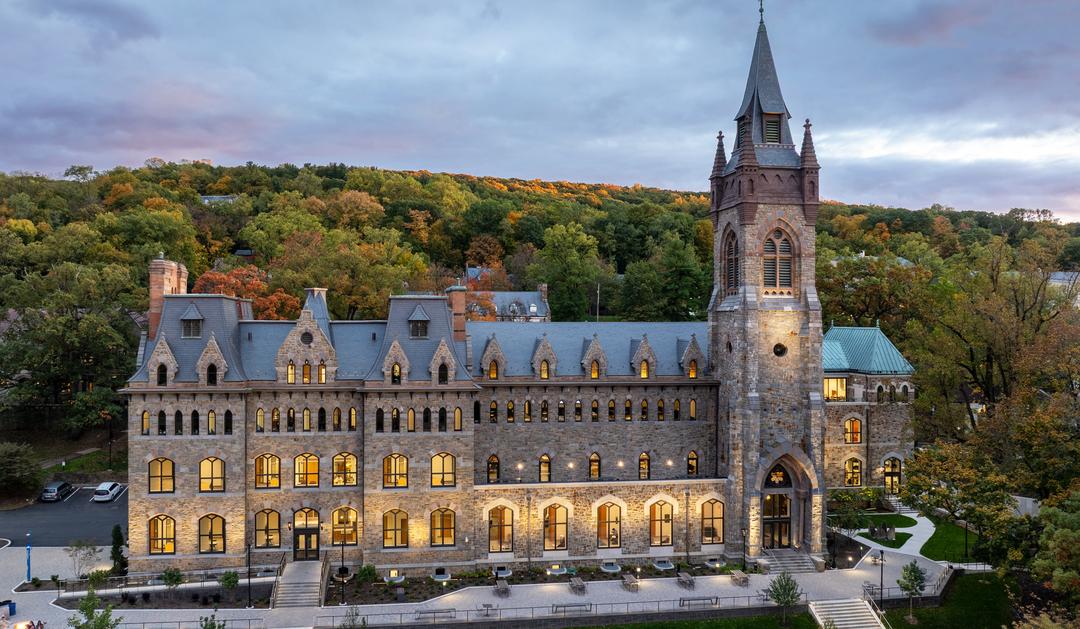
Photograph of a lit Gothic stone building and tower at dusk against a wooded hillside.

Student Fulbright Scholars Help Lehigh Reach Record Number of Recipients

Getting your Trinity Audio player ready...

Two student recipients and an alternate, along with nine faculty scholars, set a Lehigh record for a single academic year.

Story by

Stephen Gross

Photography by

Halkin Mason

Lehigh continues its extensive and committed history with the Fulbright Scholarship program as two students have been named recipients of the award for the 2026-27 academic year while another has been selected as an alternate.

Afiwa Afandalo ’24 will be traveling to Cameroon to serve as an English teaching assistant and Kendalin Flores ’26 is headed to the Dominican Republic as a marine biology researcher. Karina Makhani ’26 is an alternate for the Master of Applied Sciences and Engineering: Computer Science at Vrije Universiteit Brussel (VUB) in Belgium.

Combined with nine faculty Fulbright Scholarships this academic year, Lehigh has set a record for most recipients in a single cycle. In 2018-19, Lehigh had six total scholars and last academic year the university had its second-highest cycle with five combined students and faculty members.

The milestone reflects Lehigh’s collaborative environment, which prepares students to stand out on the world stage, as Bill Hunter, director of fellowship advising and UN Programs, noted.

“Lehigh’s interdisciplinary approach to education, and the purposeful development of students with self-other-world perspectives, is really attractive to the Fulbright Commission,” Bill Hunter said. “Through the Fulbright Scholarship, our students become Future Makers on a global scale. While this is a record year, our current students and faculty are well-positioned to win even more Fulbrights. We hope to shatter this record in future years.”

The Fulbright Program is the flagship international academic exchange program sponsored by the U.S. government, which aims to foster mutual understanding between the U.S. and other countries since 1946. The program awards approximately 9,000 students, scholars, teachers and professionals from the U.S. and more than 160 countries each year, according to the Fulbright Program website.

The awards give recipients the opportunity to turn their purpose into tangible human and scientific impact.
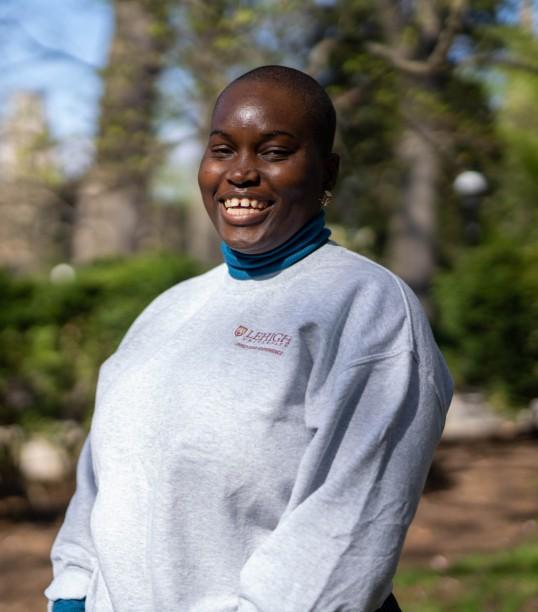
Headshot of a woman wearing a gray sweatshirt with foliage behind her on campus

Afiwa Afandalo ’24 will be traveling to Cameroon to serve as an English teaching assistant.

Afandalo, who double majored in Africana studies and women, gender and sexuality studies and double minored in studio art and English at Lehigh, is currently teaching third grade at an elementary school in Brooklyn. While she hasn’t received her placement yet, she knows she’ll be teaching in Yaoundé, Cameroon’s capital city.

A Togo native, Afandalo said she loves traveling throughout the continent and learning about other cultures. She had a positive experience as an education intern in Uganda through Lehigh’s Iacocca International Internship Program (IIIP) and wanted to return to Africa.

“My students were phenomenal, amazing,” Afandalo said. “It was a really great experience. I wanted something like that again. And Fulbright is one of the opportunities for me to be on the continent doing something similar.”

When she began to think about applying for a Fulbright Scholarship, Senegal and Cameroon were the first countries that came to mind. As she looked into both countries more, she felt Cameroon was a better fit and was also fascinated by their bilingual education system of English and French.

Many of the students she currently works with are bilingual and struggle with learning in English, as she did when she first arrived in the United States.

“When I saw that Cameroon has this dual language system where the student can choose whether to learn in English or in French, I was very excited,” Afandalo said. “This is something that I think will be very beneficial for a multicultural place like New York City to adopt."

While trying the local food and new dishes is at the top of her list once she arrives in Cameroon, Afandalo said she’s really looking forward to connecting with her students.

“What are their goals? What are the things that they want to achieve? And how can I bring my knowledge and help them get where they want to get?” Afandalo said.

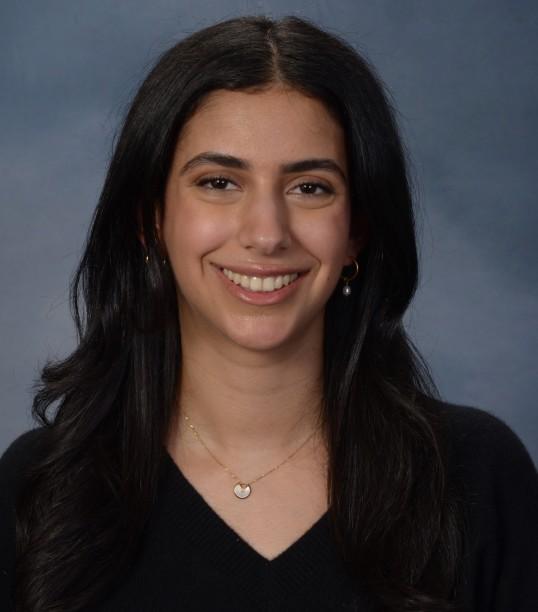
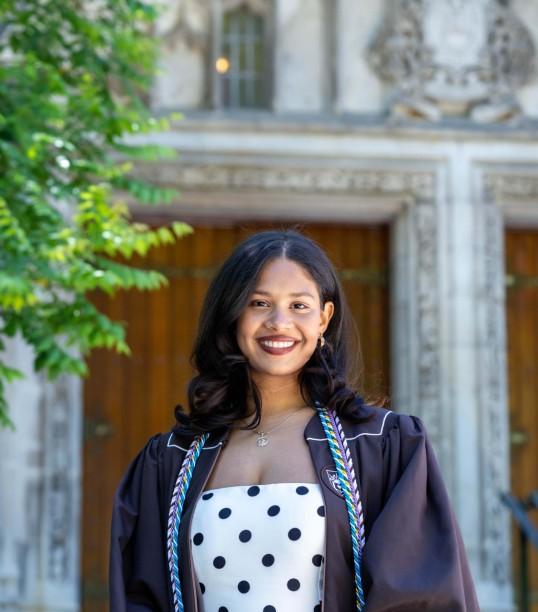
Professional headshot of a woman with dark hair and a dark blouse in front of a blue background

Kendalin Flores ’26 is headed to the Dominican Republic as a marine biology researcher.

In the Dominican Republic, Flores is embedding herself in a vital cross-sector partnership. Based in Bayahibe and working directly with the Fundación Dominicana de Estudios Marinos (FUNDEMAR), Flores said she will be developing an AI-forecasting model that predicts when coral spawning occurs. Her day-to-day work will be a mix of “dry lab” work, which consists of digitizing FUNDEMAR’s historical data and coding the model, and "wet lab" field work—physically being out on the reefs during the 2027 season to see if her model predictions match what the coral are doing in real-time.

“It’s the perfect synergy of personal and scientific reasons,” Flores, a bio-computational engineering graduate, said. “Scientifically, FUNDEMAR has a gold mine of data. Personally, the DR is home. My native Latin and cultural roots mean I can hit the ground running, working with local dive teams and students in a way an outsider might struggle to do.”

The project allows Flores to work alongside and with the community, rather than just studying it. She’s most excited about the community workshops, knowing how rewarding it is to teach middle and high school students and show them technology and conservation “belong together.”

“This is the bridge between my identity and my career,” Flores said. “It’s a chance to take my Lehigh education and give back to the ecosystem that shaped me. To me, Fulbright isn't just a research grant; it’s proof that I can use my biocomputational engineering background to make a tangible, data-driven difference in the fight against climate change.”

While Makhani, a computer science and business major, is awaiting to see if she will receive a grant, she believes being selected as an alternate has been rewarding in itself, especially for a program that she said only extends five study research awards.

“Being recognized for my work, having that external validation that what I want to do with my life is worth the possibility of a grant that’s pretty competitive, it was definitely a nice feeling,” Definitely an honor,” Makhani said.

Story by

Stephen Gross

Photography by

Halkin Mason