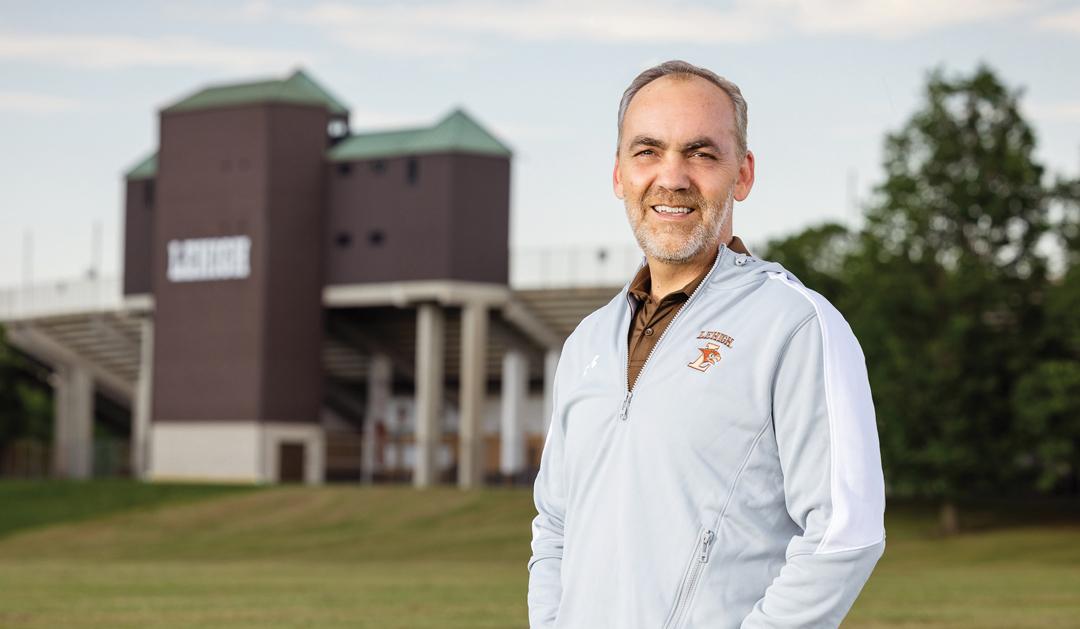
Photograph of a smiling man in a grey jacket in front of an athletic stadium.

Jeremy Gibson P’28, Murray H. Goodman Dean of Athletics

Bringing His Own Shoes

Getting your Trinity Audio player ready...

Jeremy Gibson is Lehigh’s first new head of the athletic department in 36 years. While respecting the past, he’s looking to make his own mark.

Story by

Stephen Gross

Photography by

Marco Calderon

Jeremy Gibson P’28, Murray H. Goodman Dean of Athletics, is a bit of an anomaly in college athletics. In a career spanning nearly 30 years, he’s been at just two other institutions. He spent nearly 17 years at Harvard working his way from intern to senior associate director of athletics, and 11 at Merrimack as vice president and director of athletics where he helped lead the college's transition to Division I. Starting at Lehigh last year, Gibson already oversaw the sanctioning of women’s wrestling as a varsity sport and looks to maintain the foundation of the department while finding additional ways to strengthen and support Lehigh Athletics.

What drew you to Lehigh?

When I heard Joe Sterrett '76 M.Ed.'78 P'03 P'05 P'07 P'09 [former Murray H. Goodman Dean of Athletics] was retiring, I was intrigued. There was an element of each of my prior institutions embedded within the role at Lehigh. Obviously, a truly exceptional academic institution with deep history and traditions around athletics, like I experienced at Harvard, but also a little bit of an entrepreneurial spirit that was similar to what I experienced at Merrimack. … I visited and quickly fell in love with the campus and the vision I came to understand from President Helble—and how Athletics could help achieve it. It didn't take long to realize that, yes, the campus is amazing, but the people are really special. Fast-forward a year and a half from Lehigh just coming onto my radar to moving here, having my younger son transfer from Villanova to Lehigh and my older son is enrolled in Lehigh's Catastrophe Modeling and Resilience program. Now I'm not just the Dean of Athletics, I'm a Lehigh parent two times over and seeing why this university has such a strong generational tie for families.

You have Eastern PA ties. How are you settling into the Lehigh Valley?

Yes, my middle and high school years I lived in Wayne, Pennsylvania—Conestoga High School —so there’s a level of familiarity for me. I hadn't spent a ton of time in the Lehigh Valley, but we are proud Bethlehem residents now. It's great for us to be embedded in this community. We found a home right across from the Goodman Campus and we walk the dogs around the campus every night. It gives us a chance to see the student-athletes actually doing what they do… and they love seeing the dogs!

Did you give any thought to stepping into a role that someone held for nearly 40 years?

As you can imagine, over 19 months, a lot of people have made the comment, ‘You've got really big shoes to fill.’ And from day one—it made Joe laugh the first time I said it—I said, ‘Well, Joe's keeping his shoes, and I brought my own, so it all kind of works out.’

Joe did so much of this role exceptionally well, but what he did better than anything is hire good people. I came into a large department with a great staff of people who value what they do. They value being part of the educational process, a sentiment which is becoming more and more rare in college athletics, but I’m truly surrounded by people, whether it's coaches or administrators, who view themselves as educators and developers of young people. My role now is to steward that and figure out how we can take this amazing foundation, and modernize our enterprise, because the market demands that. Competitive teams matter. … They amplify our brand. They give us opportunities to talk more and more about all of the great things outside of athletics that are happening at Lehigh.
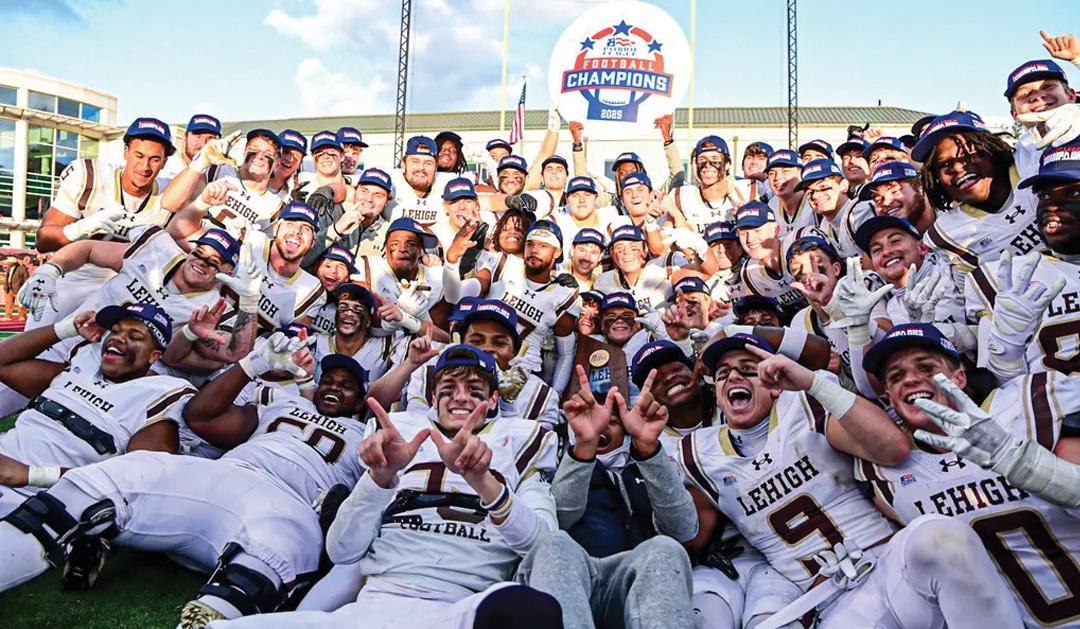
Photograph of Lehigh football players celebrating a championship victory.

What are you most proud of so far?

The connection with our student-athletes. That's my favorite part of this job, being able to be at a place where we have nearly 750 varsity student-athletes, who are exceptional and committed in so many ways. I get to be around them every day and get to try to understand what it's going to take to give them the type of experience that they're looking for. I think the culture across our athletics program is an important reason why, despite the changes to the transfer portal rules, our student-athlete retention at Lehigh has stayed consistently high and remarkably high in comparison to most Division I programs. I am proud that we have student-athletes who are choosing Lehigh because they are looking for the complete and rigorous experience that Lehigh offers. It's our job to fulfill that expectation. It's our job to give them a great experience. It's our job to make sure that we're helping them create good outcomes as they graduate from Lehigh. We need to help create pathways to connect with Lehigh’s amazing alumni networks. The impact of these connections are very real. That's real Lehigh.

What are your priorities going forward?

We're going to keep our feet firmly planted in the foundation of who we are. Our identity is not going to change. We're going to be an athletic program where people who compete for our teams are going to be students who are truly representative of the institution. And we're going to compete in a way that makes our community proud. … It is a fundamentally different college athletic landscape than it was 19 months ago when I walked in. The NIL rules remain unsettled, the transfer portal continues to impact roster stability and now there is five years of eligibility for every student-athlete. We need to be thoughtful and strategic about how we can position Lehigh to be even better within those parameters rather than just have these changes happen to us.

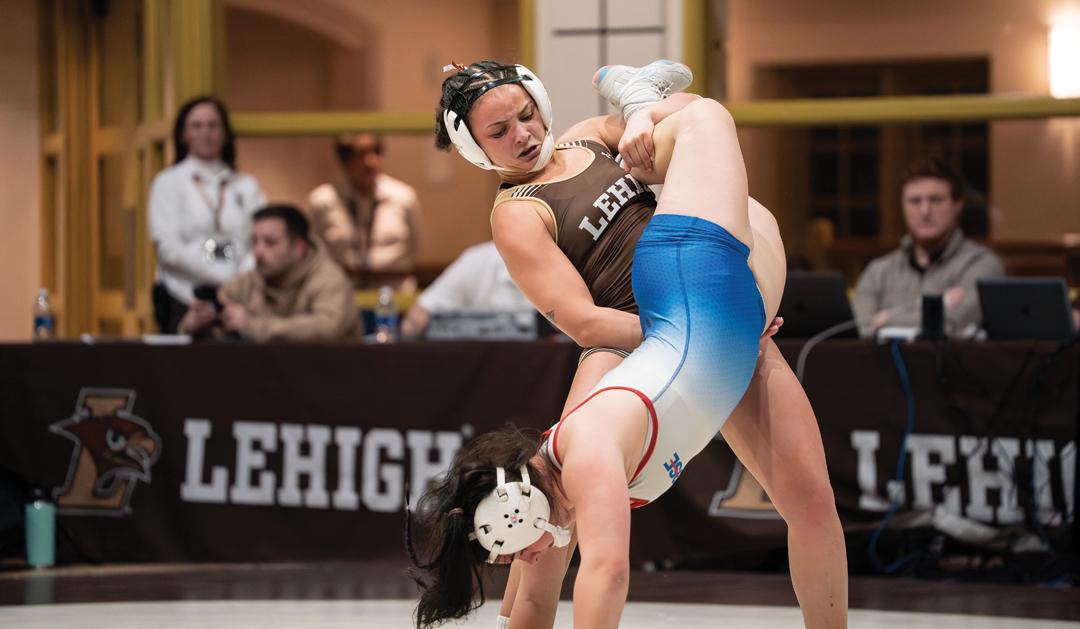
Photograph of two women wrestling; a Lehigh wrestler throws her opponent mid-match.

Will there also be additional support for women’s athletics?

Lehigh already has outstanding women’s athletic programs, has enjoyed sustained success in basketball and softball, and we have seen championship teams across other programs. We want more of our women to be positioned to compete for championships while they continue to be exceptional academically. Nationally, many institutions that have had significant competitive success in women's athletics are our academic peers. One of the first things that we did when I arrived was elevate women's wrestling to varsity status. That's a credit to [deputy athletic director] Sue Troyan as much as anyone. Sue was working on that for a long time, and had it really well-positioned. That was an important thing for Lehigh to do. Wrestling has been part of Lehigh's DNA for a century—it’s great to have our women competing and succeeding, and we need to support them so their success can continue.

How are you building out the programs? What support will that take?

From a philanthropic standpoint, our focus is going to be built on three primary pillars. One is going to be about building endowment around coaching. In athletics, we look at our coaches as our faculty, so making sure that we have the recurring income from endowment to help us be able to attract and develop outstanding people, that is going to be critical to what we do. We need to advance the enhancement of our athletic facilities, so we need to make an investment to modernize the spaces in which we train and compete. The Goodman Campus is an amazing resource and we need to create and leverage investment opportunities to make sure it stays an advantage to Lehigh. This means creating the conditions where our athletes can train in more modern ways with the modalities that they need, with the technology that they need, with the access to data and research around athletics that is going to differentiate us and create real advantages. That's where I go back to talking about integrating with the academics and working with the brilliant people on this campus who can help us actually enhance athletic performance. It is important for us to not just align with, but to integrate our athletics programs with the important and impactful research being performed across the university, and we need our facilities to be able to support that. The third is going to be in how we apply our resources to make sure we are providing outstanding experiences for our student-athletes. We need to evolve in a way that is both ambitious and true to who we are.

What are your personal thoughts regarding name, image and likeness (NIL) deals in college athletics?

College athletics has turned into a multi-billion dollar industry. For a long period of time, aside from financial aid, which is significant, student-athletes were outside of the financial model. I think valid NIL deals are good. They’re good for a student. They're good for the entity that they are representing. I do have concerns about their preparedness to participate in the model. I worry that they're getting good advice and the support that they need around financial literacy. I worry about what longer term impacts NIL in alignment with the transfer portal will have on graduation rates. It is why it is more important than ever that Lehigh focuses on being a university where we truly believe in the scholar-athlete model.

Has the NIL impact on Lehigh been small?

It's more substantial than people realize. We have a lot of student-athletes who have NIL deals. The vast majority of them are below the $600 level the NCAA set for a reporting threshold, but we absolutely have students partnering with local businesses. And on the other extreme, we're an athletic program that has national champions. We have students who are competing at the highest level of their sport, so we have some who have created significant value around their name, image and likeness. I think it’s important for a student to understand they participate in NIL opportunities at Lehigh, but we're going to engage in a way that feels right based on our culture and values.

How is Lehigh approaching the transfer portal?

We want to not give them a reason to consider leaving. Our student-athletes are very selective. They are looking for a certain experience, which is why they choose Lehigh in the first place. They want a rigorous academic experience, they want a Division I caliber athletic experience, and they want a residential campus experience that will collectively produce an amazing four years. And they want to be positioned to succeed when they graduate. Lehigh provides all of that, which is why our transfer rates have remained very low.

If student-athletes aren’t increasingly leaving, can Lehigh make it a positive by bringing in additional student-athletes?

The opportunity for student-athletes to transfer has always been there. It’s just that rules around it have changed in terms of immediate eligibility and being able to transfer multiple times. We're hoping that we never see a significant spike in the number of students who transfer out, and I don't think we are looking to have a large infusion of transfers coming in. If you watch the NCAA basketball tournament, there are teams that have all new players every year. Nearly 40% of eligible returning Division I men's basketball players nationally went into the transfer portal. If we're going to be about developing young people, we can't do it in a transient way. That's not a one-year experience. That's not building a culture. That's not building a team. What we're focused on is recruiting kids out of high school who are going to come in and develop into the student-athletes that we're hoping are going to be productive, and in doing so, create a culture that they want to stay and be a part of.

Story by

Stephen Gross

Photography by

Marco Calderon