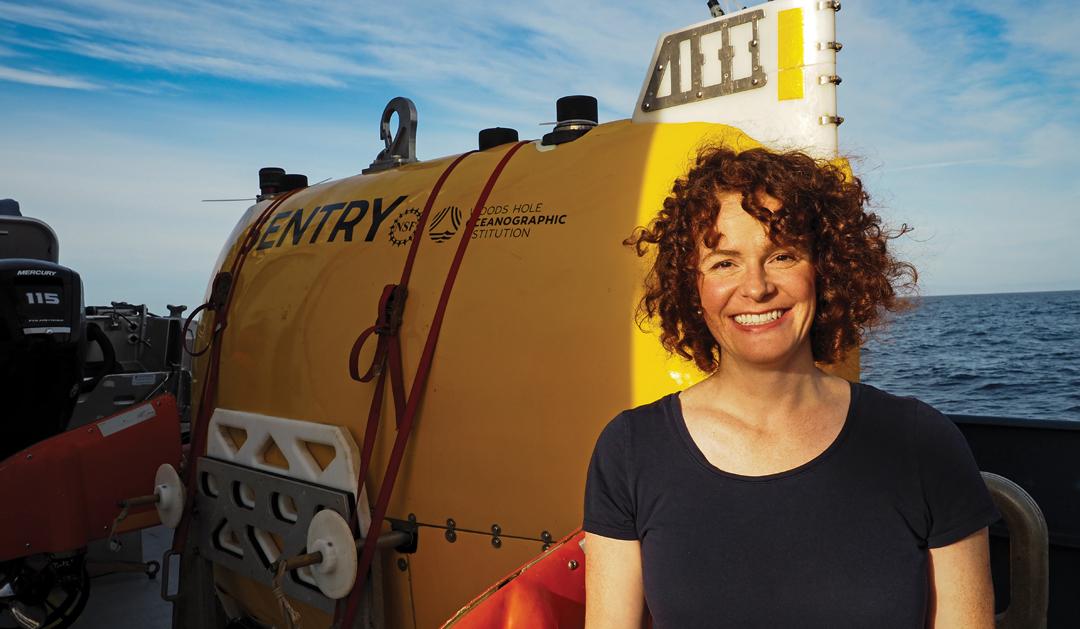
The East Pacific Rise is a north-south trending mid-ocean ridge segment in the eastern tropical Pacific. McDermott and her research team sail from ports in California, Costa Rica and Panama to study the area, and spend about 20 to 30 days offshore at a time.
That specific part of the mid-ocean ridge is what McDermott calls “fast-spreading,” which means that it erupts fairly frequently, about every 15 to 20 years. It's also the site where there's been two previously documented eruptions: one in 1991-1992 and another in 2005-2006.
McDermott explained that the National Science Foundation (NSF) previously invested in a multidecadal study where there was frequent ship and deep submergence coverage at the site with a 30-year-long history of multidisciplinary observation.
She and her team selected the site for their NSF project proposal because there was a wealth of prior knowledge from the previous NSF study and an expectation that the volcano would erupt again within the time span of their study.
The team began their research in 2018. To begin conducting field research, they used Sentry, an autonomous underwater vehicle operated by the Woods Hole Oceanographic Institution, to map the axial summit trough, a linear depression where the deep-sea volcano tends to erupt. They did this with the anticipation that they would need a high-quality map to understand what new lava flows would look like in the event of an eruption and quantify its effects.
After creating the map, they developed a model to forecast the eruption. The premise of their model related to their observations of hot spring temperatures.
Deep in the ocean, water boils at a higher temperature than what we experience at the Earth's surface due to the effect of pressure, McDermott explained. The volcano they studied sits about 2.5 kilometers underwater and the pressure is about 250 times the pressure we feel on land. That pressure, she said, increases the boiling point of sea water to a predictable number, 390°C, which is almost four times the regular boiling point of fresh water.
McDermott and her team observed that certain hot springs have the closest connection to the magma lens, melted rock that's at depth in the volcano.
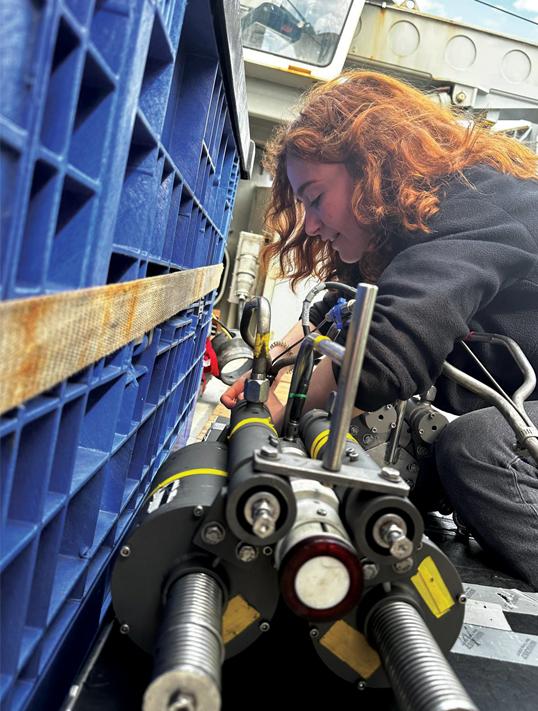
Next, the team added temperature sensors to the vents over the magma lens and started tracking those temperatures. The sensor loggers provide high-resolution data and take a measurement every 10 minutes for up to two years.
They were able to check whether the vent fluids were getting hotter. The volcano’s “Bio9” hydrothermal vent hit its boiling point of 390°C right at the time of the last eruption in 2005-2006. Based on that observation, their own research, temperature measurements and statistical modeling, the team projected that the volcano would erupt in January 2025 with an error window of 1.5 years.
McDermott and her team went to the site on a cruise in February 2025 and observed that although the vent plumes were strong, there was no evidence of new lava on the seafloor.
“That was initially a little disappointing because we'd hoped to see an eruption, and also, that marked the end of our funded project,” McDermott said. “We didn't have any more ship time, but you make the best of it.”
The team made more measurements and observations, collected hot spring fluids and temperature data, and redeployed sensor loggers. They submitted a peer-reviewed research paper with their prediction on April 27, 2025.
When Was an Underwater Volcano Eruption First Witnessed in Person?
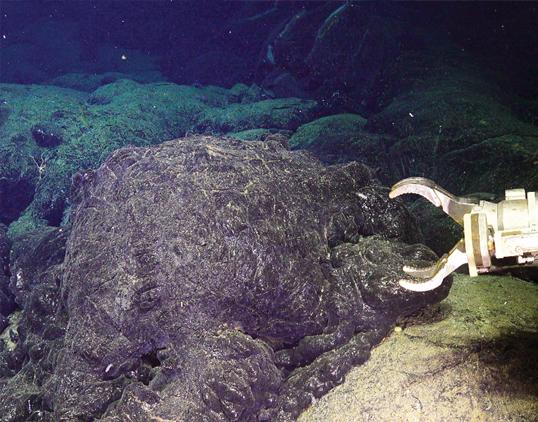
A separate research expedition led by Wozniak at the University of Delaware dove at the site in a human-occupied submersible vehicle on April 29, 2025. Instead of the usual vibrant marine life, the crew witnessed glowing, red-hot lava. The volcano was actively erupting.
“This was the first time any humans had ever seen this,” McDermott said. “They dove at the same place the day before and there was nothing then—it was normal.”
“What’s really exciting for science is not only was our prediction right, which has never happened before, but we knew the timing of the eruption exactly, which has also never happened,” McDermott said. “It shows that not only do we have the ability to forecast the eruption successfully, but also we have this huge opportunity to understand the post-eruption aftermath in an unprecedented time series, starting with the day of eruption.”
How Do Underwater Volcanoes Affect Earth’s Climate?
According to McDermott, volcanism is a vital part of the Earth's ecosystem and controlling its climate. Volcanoes erupt, form new rock and are found at the bottom of the seafloor and continental systems. They release gasses, such as carbon dioxide (CO₂), which acts as a greenhouse gas in our atmosphere and has climate implications.
“This balance between how much volcanism is happening versus how much CO₂ sinks solid forms, whether it's rock or plant material, is important to controlling Earth's climate,” McDermott said. “So it's important to get a handle on how much volcanism is taking place.”
Most of Earth's volcanism happens in the ocean, not on land. About 25% of all the heat that's released from the Earth happens on land in volcanoes that we can see, observe and monitor, while the majority happens in the oceans, she said.
“Submarine eruptions are the most common type of volcanism we have on the planet,” McDermott said. “They happen in lots of different tectonic environments—places where there's some differences in the types of volcanoes that are there.”
One of those environments is the global mid-ocean ridge, home of the East Pacific Rise and one of the largest geologic features on the planet. This underwater mountain chain is 65,000 kilometers long and encircles the earth, like the seams on a baseball, McDermott said.
McDermott cited recently published research that estimates that there have been more than 300 submarine eruptions observed in the ocean, but during the same amount of time, tens of thousands have been observed on land. This implies that researchers have missed tens of thousands of eruptions occurring in the ocean.
“About 39 eruptions have been seen along the mid-ocean ridge, and yet that's the largest volcanic feature,” McDermott said. “Those mid-ocean ridge eruptions are vastly under-detected because they're deep, and they don't create any kind of surface signal.”
In order to study them, you need expensive deep submergence technology, such as a submersible vehicle and a long-range, long-duration ship. What’s more, coverage of the ridge line during a research expedition can be sparse, and the chances of seeing an eruption are small, which makes the April 2025 eruption observation an incredible discovery.
What Happens to the Seafloor and Hydrothermal Vents After an Eruption?
The post-eruption aftermath is now the primary focus inside our labs. Securing a new, Lehigh-led NSF award in fall 2025, McDermott returned to the site in January 2026 to gather highly time-sensitive fluid samples before the ecosystem shifts back to equilibrium.