



One day while driving his sleeping kids in his car, Fan Zhang was thinking about the first-generation Ray-Ban Stories smart glasses.
What if, the senior research engineering manager at Meta pondered, you could take the camera from those glasses and pair it with AI to aid someone who is blind or low-vision? He took advantage of Meta’s global hackathons—a few days out of each year set aside where employees can work on something outside their normal workload—and posted on the company’s internal message board asking if anybody wanted to help him with the project.
That message sparked the creation of a number of subsequent generations of the glasses, which include AI, and can help the person wearing them achieve tasks such as reading a menu or finding their keys.
“It's really important that you're not building for someone who's blind or someone who's deaf and hard of hearing,” Zhang said. “Bring them onto your team. That's the real way to actually build the right type of product.”
Zhang, speaking virtually through pre-recorded video, highlighted his work as the first of two keynote speakers at the Summit on AI-Enabled Assistive and Rehabilitation Technologies hosted by Lehigh’s CDAT (Center for Community-Driven Assistive Technologies) on November 16. He also stressed one of the main themes throughout the day: including those with disabilities in the development of the technology.
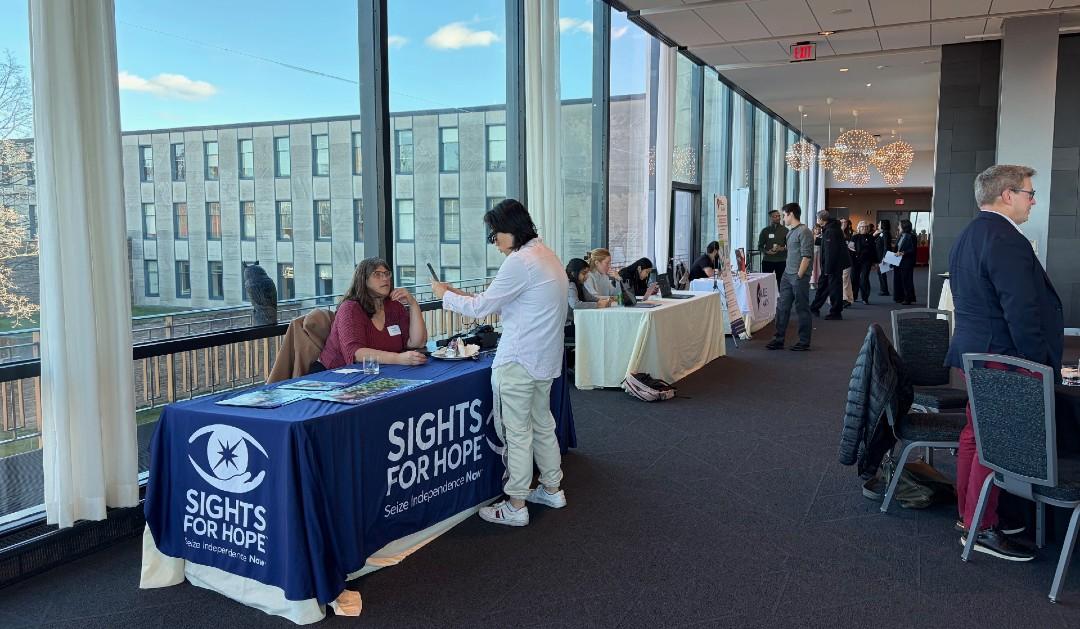
The day-long, collaborative working conference in the Wood Dining Room at Iacocca Hall brought together people with disabilities, healthcare professionals, academic researchers, tech industry leaders and state and federal stakeholders, and showcased solutions while also addressing the future of AI in disability care.
Kate Bullard, senior director of research development, Provost Nathan Urban and Vinod Namboodiri, director of CDAT, Forlenza Chair of Health Innovation and Technology and professor of computer science and engineering, kicked off the event welcoming attendees. A video message from U.S. Senator Dave McCormick also played.
Namboodiri helped start the day by highlighting some of the projects, such as the MABLE (Mapping for Accessible Built Environments) app, and partnerships, such as the 10-year pact with Good Shepherd Rehabilitation, created through CDAT.
“It's a broad range of things people do at CDAT, but it all comes together because the focus is always quality of life for individuals with disabilities,” Namboodiri said.
Namboodiri said the center is committed to keeping a community focus and they also plan to add additional research partners.
Urban’s hope for attendees was that they found the content throughout the day interesting, but also were able to build relationships that fostered collaboration and innovation.
In his keynote, Zhang offered an example of how partnerships in the space can work as he said Meta partnered with a company called Be My Eyes, which includes a network of 10 million volunteers and one million people who are blind. They’ve worked to allow anybody needing assistance to livestream from their glasses and be paired with one of the volunteers.
The glasses’ device access toolkit has recently become more widely available, allowing anybody with the interest and technical abilities to develop their own apps for the glasses.
Rory Cooper, founder and director of the University of Pittsburgh’s Human Engineering Research Laboratories and a senior research scientist with the U.S. Department of Veterans Affairs, also delivered a keynote, emphasizing the importance of involving end users in technology development. He noted that solutions designed for those with a disability often benefit everyone.
“Any technology that is currently available or going to be available in the future needs to engage people with disabilities,”Cooper said. “That's the only way that we're going to make it successful.”
Cooper went on to cite that despite being 25% to 30% of the population, studies have shown the percentage of those with disabilities who have a patent is in the single digits.
When it comes to AI, Cooper said the conversation should focus more on how end users are using it themselves. He said there’s a project he’s currently working on that focuses on simple adaptations of recreational devices and they’re finding people can use chatbots to come up with real computer-aided design (CAD) models.
“It needs a little bit of work on the selection of materials, material processes for those CAD models,” Cooper said. “And then of course other people are also developing apps and software solutions as well. When it's all kind of consumer-driven, you lose a little bit of the validation and the software engineering aspects but it's really kind of cool that we're going to see not only more consumer-driven and more of a collaboration, I think due to AI tools.”
Prior to a networking lunch, expo and research showcase and afternoon breakout working tables on community priorities, there were two panel discussions.
The first panel focused on life transitions and independent living while the second discussed mobility, smart spaces and physical access. Both wove AI throughout the conversations ranging from how AI is changing work, accessibility and what happens if we depend too much on AI.
In the first panel, Josie Badger, executive director of the Governor's Advisory Commission on People with Disabilities, addressed this directly, giving examples from her own experience.
She said some of her young commissioners are brilliant, but their disability makes it hard for them to put their thoughts into words. But AI has been helping them deliver speeches or become speech writers.
“That is wonderful,” Badger said. “I like them to get their words out to others to help them understand what is needed in disability and for advocacy for their jobs.”
One way she uses AI herself is summarizing a long piece of legislation using simple, plain language.
“We need to seek out how we can further emphasize the power that AI has to make things accessible for all people,” Badger said.
That conversation continued in the second panel with Angie Whistler, researcher at the Public Policy and Research Institute and American Foundation for the Blind, asking attendees to raise their hand, if they’re able, if they ever felt they were the odd person out in a room because they were different or had to do something in a different way than others. A sea of hands went up.
“That alone should cause us to look towards AI as a possibility to reduce it so no hands get raised in the future,” Whistler said. “But it has to be functional first. It has to be affordable first. It has to be accurate first. Because one of the biggest things we need for accessibility is reasonability.”
The summit wrapped up with a closing synthesis, as well as a white paper working group.