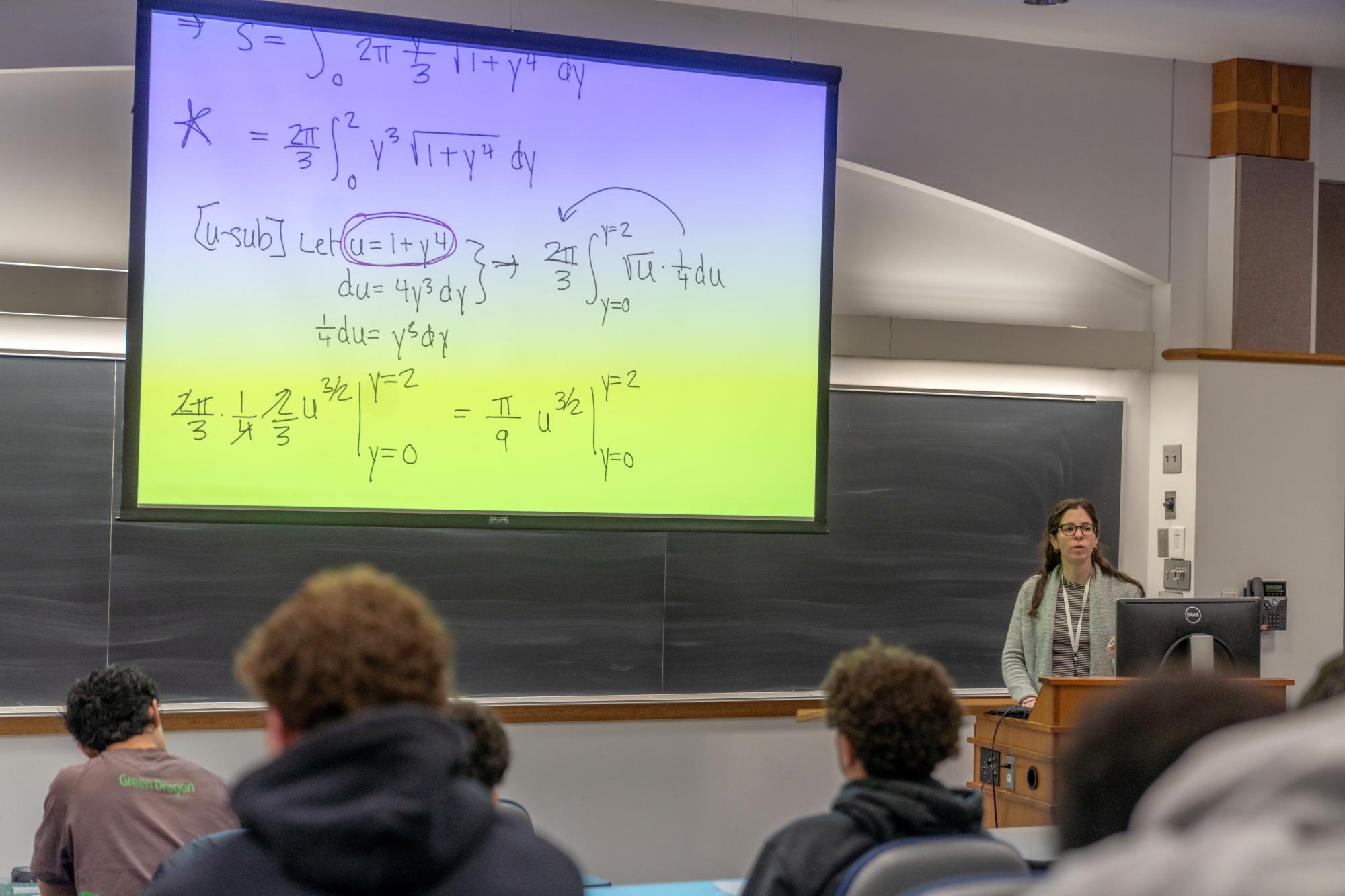
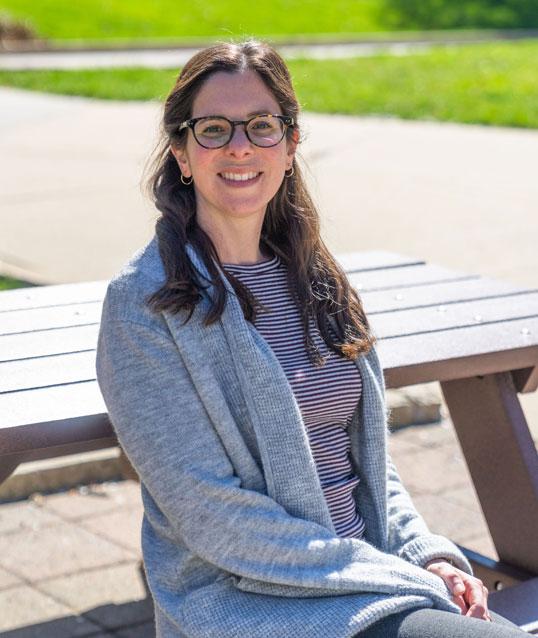
Megan Cream, teaching associate professor of mathematics, also introduced a courseware system from ALEKS into the department’s pre-calculus program and prepared and developed the materials for an adaptive learning system that meets students where they are in their mathematics learning.
“We wanted to make sure that our classes are not the ones that are holding students back,” Cream said. “We don’t want our classes to be the gatekeeping classes, and we still want to make sure that our standards are high enough that students are getting what they need out of the courses. I’m so proud of the work our department has done to lower DFW rates, but it is important to note that there are other metrics that are part of the story, too. We hope to look at success in subsequent and related courses, as well as graduation rates and overall college GPA to understand the full context of these positive outcomes.”
Fostering a Sense of Belonging
Faculty members like Cream were inspired by the success of social psychologist Kevin Binning’s “sense of belonging” activity, which helps students overcome self-doubt and feel that they belong in the classroom. Binning’s intervention helps students understand that adversity is temporary through reflection writing, story sharing and group discussions.
Essentially, Cream said students participate in reflection writing where they log any concerns they may have about a particular course or, more generally, adjusting to college. Next, they read stories from students who had struggled in the course, but then reached out for help and were able to succeed. Afterwards, the students discuss the stories in small groups before the activity culminates in a class discussion.
The activity has been shown to close performance gaps and increase class attendance, retention and overall GPA of students, Cream said.
Cream worked with Donna Mohr, director of retention, and Isaak to implement the activity in classrooms at Lehigh. It was first launched in Isaak’s Calculus I (MATH 21) and Cream’s Calculus II (MATH 22) courses taken mostly by first-year students during the fall 2024 semester. During the fall 2025 semester, It expanded into all of the department’s Calculus I (MATH 21), Calculus II (MATH 22), Survey of Calculus I (MATH 51) and Calculus with Business Applications (MATH 81) courses.
“We're subtly trying to let students know that if they struggle, that's okay and we can work through that,” Cream said.
Since implementing the activity, she said more students have been attending her office hours and are more open to sharing their vulnerabilities and concerns.
Encouraging Participation with Active Learning
In courses once taught mostly through lectures, mathematics is being transformed into an engaging experience that puts student understanding at the center through methods of active learning.
Napier said these active learning methods were developed in response to larger discussions regarding the effectiveness of traditional lecture methods. While the department still utilizes the lecture method, they have explored incorporating active learning methods “in a mild way, but to big effect,” he said.
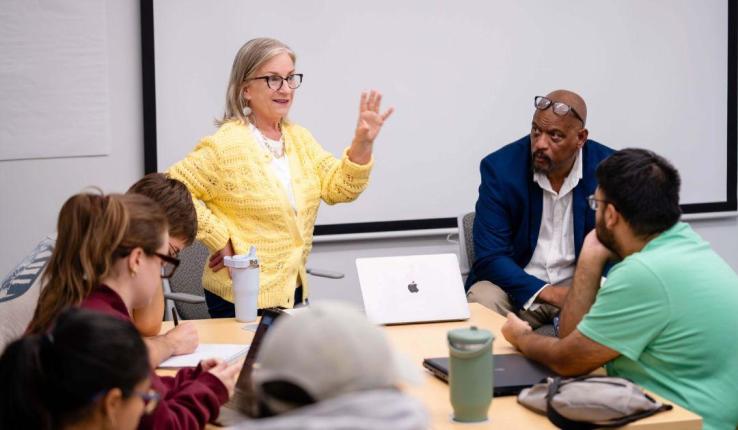
For example, Cream said she injects bits of active learning into her courses by introducing "knowledge checks,” where she pauses at least once per class and lets students work on a problem on their own or in groups, but without her immediate guidance. She then addresses any questions or setbacks the students encounter as she goes over the problem with the entire class.
“It's my little way of combating robotic note-taking, and it's also a way to increase attendance, because we attach some credit to it in the form of bonus or attendance points,” Cream said.
Since starting these checks during the spring 2024 semester, Cream believes attendance has increased in her classes and is contributing to better student outcomes and participation.
“It's natural for students to be nervous about contributing to a large class, but with the knowledge checks, they can bounce their ideas off other people and have more confidence,” Cream said. “I found it increases participation and it makes the classroom feel more intimate and smaller in a way.”
She noted that the knowledge checks have also spread to other classes within the department as faculty members adapt it to their curricula.
“I hope that what we’re doing can be extended to even more classes,” Cream said. “I would love if we could extend some of the things that are being done in math outside of the math department in other classes in the College of Arts and Sciences and even beyond the walls of the college.”
To jumpstart this, the department’s calculus committee is planning to host a teaching workshop for mathematics department faculty and graduate students. The committee, co-chaired by Cream and teaching assistant professors of mathematics Jiayuan Wang and Nick Russoniello, will share some of the tactics the department has implemented to help expand the use of methods to even more classes.
“It's one way we hope we can inspire our peers, the other instructors in our department, and maybe beyond that, to infuse these little things,” Cream said. “It doesn't have to be huge. There are little things you can do to promote student success, and I just want that message to get out there.”
Napier said the department has also invested in teaching assistant training in addition to the College of Arts and Sciences’ teaching assistant training program, which introduces the assistants to good pedagogical practices and technological tools to create successful educational experiences.
“All of these activities are really giving our teaching assistants some additional tools and incentive to develop so that later on, they can innovate in their own teaching or industry,” Napier said. “It also sends a message to our teaching assistants and to us about how important the teaching is in trying to help all students as best we can so they can be doing as well as they can.”
Applying Mathematics to the Real World