

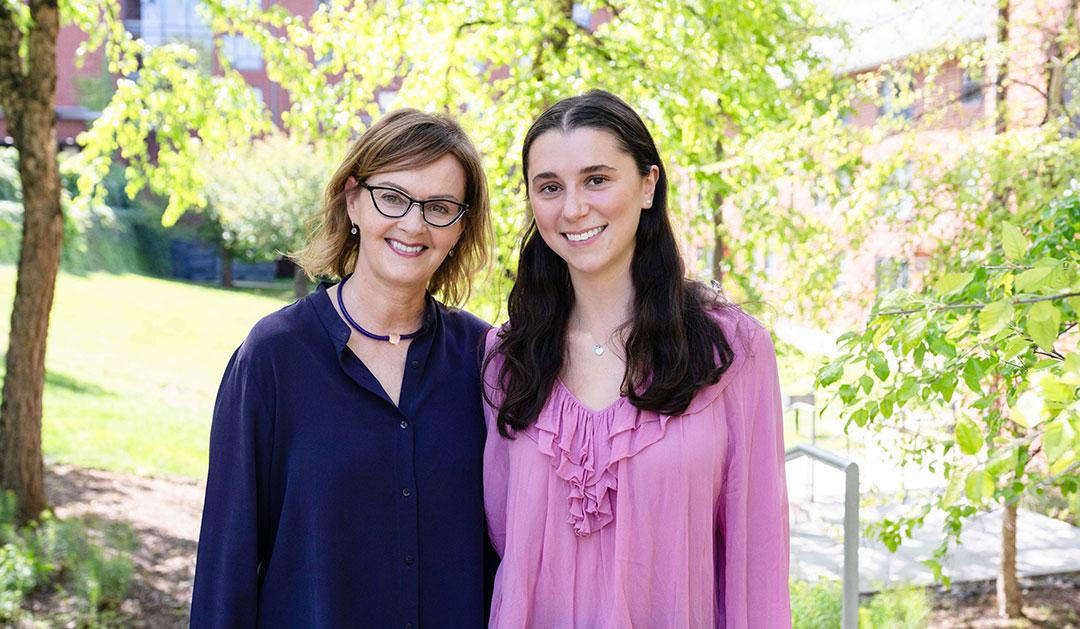


Natalie Werbel ’26 remembers walking into Global, Sexual and Reproductive Health, Rights, and Justice for the first time last fall, a course taught by Joanna Mishtal, professor and chair of population health. At the time, she was searching for direction on the kind of research and questions that felt intentional enough to pursue deeply.
At the end of the academic year, Werbel found herself back in Mishtal’s office sharing a different kind of news: she had been accepted into the Master of Public Health program at Dartmouth’s Geisel School of Medicine.
As a double major in community and global health, and health, medicine and society, the moment reflects more than an academic achievement for Werbel. It marks how quickly a classroom connection has grown into a mentorship that shaped her confidence, research interests and plans for the future.
Throughout the semester, Werbel developed an op-ed examining contradictory policies surrounding pronatalism, drawing from both social science and public health perspectives. The project challenged her to think critically across disciplines while refining her own voice as a researcher and writer.
Mishtal guided the process step by step, offering detailed feedback while encouraging Werbel to push her ideas further.
“Natalie stood out almost from day one,” Mishtal said. “She pushed ideas to the next level, had tremendous intellectual curiosity and the op-ed she wrote was very powerful.”
As Werbel began considering possible capstone topics, she realized her growing interest in reproductive health research was tied closely to the environment Mishtal had created in the classroom. She decided to pursue reproductive health research where she could continue working with Mishtal, who serves as the reproductive health capstone lead.
The partnership evolved further as Werbel moved from structured coursework into collaborative research. In a small-group capstone setting, she led a team of three students studying sex education in the Bethlehem Area School District.
The project was unlike any coursework Werbel had completed in the past, requiring new perspectives and approaches. The team interviewed representatives from the school district and the Bethlehem Health Bureau, worked through institutional review board approvals and navigated multiple layers of district permission before they could begin collecting data.
Werbel’s willingness to engage fully with both people and ideas stood out just as much to Mishtal as her academic strengths. In an era when classroom participation can easily become passive, Mishtal admires Werbel’s ability to step away from technology, engage thoughtfully in discussion and connect research to real-world experiences outside the comfort of Lehigh campus.
That same openness carried into Werbel’s work outside the classroom. While continuing her capstone research, she also began a research assistantship in the department of anthropology. Excited by the opportunity but uncertain about how to shape her work, Werbel once again turned to Mishtal for guidance.
“With Dr. Mishtal’s background in health anthropology and qualitative research, I decided to reach out to her,” Werbel said.
Their conversation extended beyond research logistics; they discussed qualitative methods, reproductive health and Werbel’s hopes for life after graduation.
Mishtal sees those moments as central to mentorship. Supporting students often means understanding what they need and are interested in discovering, even outside the boundaries of a single course or department.
“I was thrilled to sit down with Natalie,” Mishtal said. “When she told me she got into Dartmouth, I was so excited for her, but not totally surprised. She’s talented and I wanted her to shoot high.”
That support for Werbel and fellow students appears not only in major academic milestones, but also in small acts of care that shape the atmosphere of the classroom itself. Werbel recalls Mishtal beginning capstone sessions by inviting students to share something positive happening in their lives, creating a space that feels collaborative, personal and welcoming.
“She brings in chocolate and treats for us,” Werbel said. “She really cares, and it makes the environment so enjoyable—like our own community.”
Werbel said her experience at Lehigh has also been shaped by mentors across the College of Health and beyond, including assistant professors Kate Jackson, Rochelle Frounfelker and Farren Yero, who encouraged and supported her throughout her college journey.
Her partnership with Mishtal underscores how faculty-student relationships can happen at any point, emerging unexpectedly and providing lasting impact.
“Dr. Mishtal taught me how to adapt and pivot to whatever is thrown my way and that’s something I’ll be carrying with me to Dartmouth and beyond,” Werbel said.