

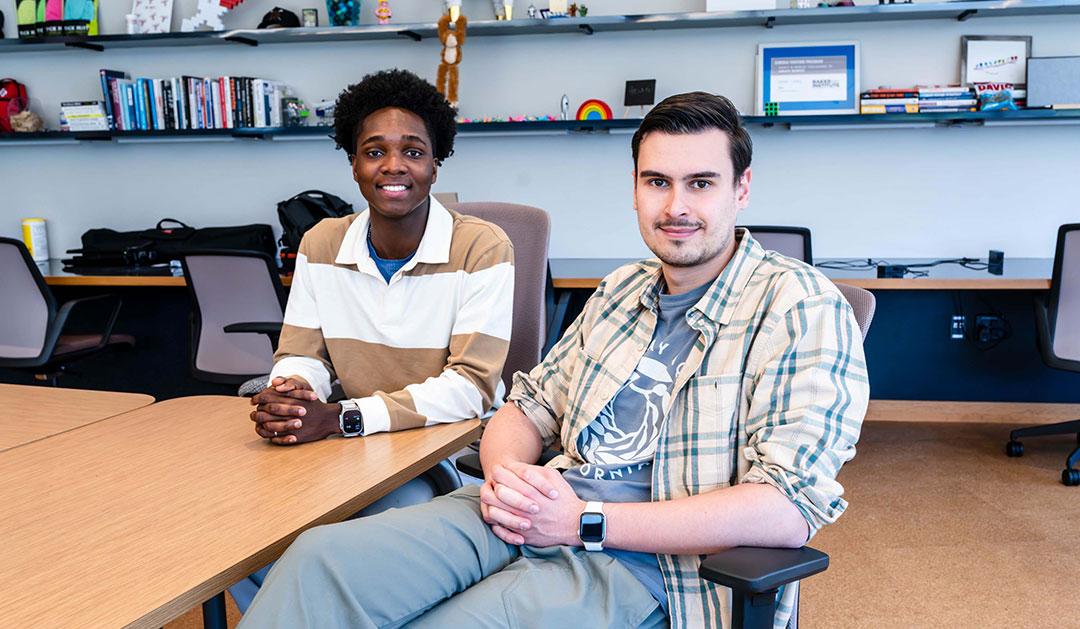


When entrepreneurs Abdulrasaq (Dulra) Amolegbe ’26 and Roman Moskalenko ’26 connected at Lehigh, they recognized a shared passion to build something together, having launched and grown their own successful startups independently.
What began as a conversation over common interests evolved into their creation of Carmel Labs, an artificial intelligence-focused startup that blends the innovators’ expertise and experiences.
The new venture signifies the next era in their entrepreneurial journeys as they prepare to work on the startup full time after graduation.
“We plan to continue to work on Carmel Labs and build and move humanity forward,” Amolegbe said.
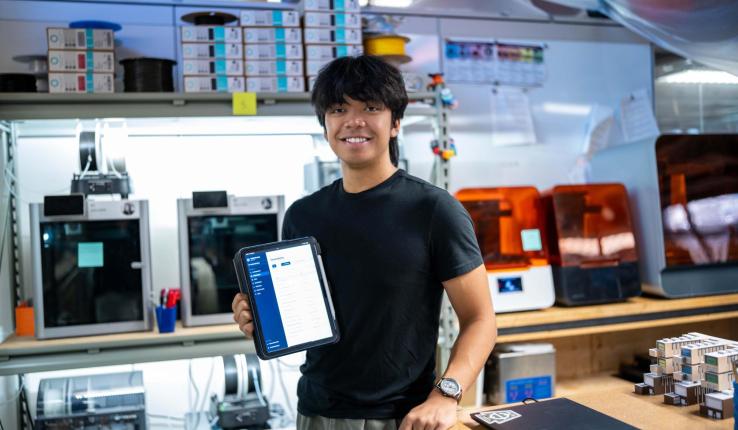
Entrepreneurs from a young age, Amolegbe and Moskalenko started their first companies respectively while they were in high school continents apart. Amolegbe, a management major from Nigeria, founded Dot, a financial services platform that created a cash-to-cashless digital experience for international students from Africa.
Moskalenko, a business information systems and management double major, moved from Ukraine to the U.S. during high school and founded LearnUA, an educational platform that teaches Ukrainian and English as a second language.
Once at Lehigh, both students said they became involved with the Baker Institute For Entrepreneurship, Creativity & Innovation and the Lehigh Ventures Lab, which provides comprehensive support for high-potential, advanced-stage Lehigh entrepreneurs.
“I always had that entrepreneurial spirit and leadership desire,” Moskalenko said. “At Lehigh, I was running that startup, and I wanted to expand on that.”
As they progressed at Lehigh and as leaders of their startups, Amolegbe and Moskalenko leveraged their resources and knowledge to grow their ventures.
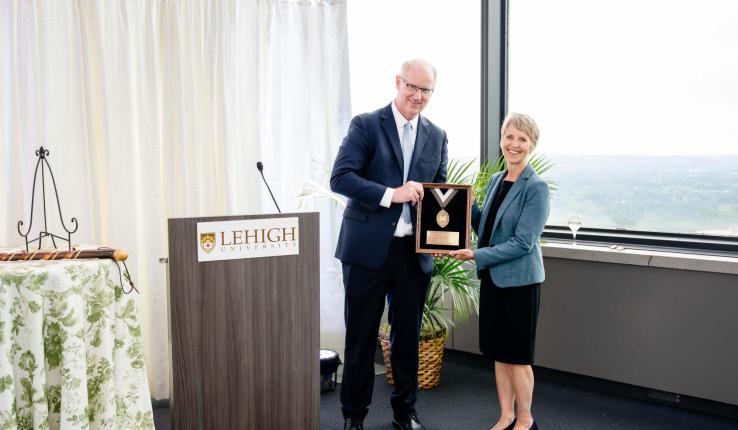
During the Baker Institute’s 2023 Innovate! Celebrate! event, Amolegbe earned both the Joan F. & John M. Thalheimer ’55 EUREKA! Award for student achievement in venture creation and the Thalheimer Grand Prize of $5,000 for Dot. He also took home several awards during the Fifth Annual StartUp Lehigh Valley Entrepreneurial Pitch Competition in 2023.
Moskalenko was awarded the Daniel Katz P’23 Family Endowment Fund for Entrepreneurship and the Office of Technology Transfer Award during the 2024 Innovate! Celebrate! event.
While Amolegbe and Moskalenko knew of each other from their time in the Ventures Lab, their friendship grew when they were roommates during LehighSiliconValley (LSV), Baker Institute's week-long winter term program that immerses students in the San Francisco Bay Area entrepreneurial ecosystem.
“At the time, Dulra was running his startup and I was running my startup,” Moskalenko said. “We got more time to learn about each other, interact and become closer friends. That experience highlighted our common interests and showed us what's possible, and gave us a lot of good contacts within the Bay Area from the speakers we talked to.”
Eventually, Amolegbe and Moskalenko said they decided to close their startups, and they began having conversations about their ideas and interests. While living in San Francisco last summer, the duo decided to join forces to create Carmel Labs based on the rapid growth of AI.
Amolegbe said they were drawn to partner on an AI-focused startup at the time since AI had gotten “significantly better and advanced at unlocking some things that were previously impossible to do.”
“We had both just left our previous companies and the timing was right and AI made enough progress,” Amolegbe said.
Carmel Labs is an AI research lab with the goal of helping build an infrastructure trust layer for AI agents. It is composed of two main products: AgentStatus and Fabric.
AgentStatus validates that AI agents work correctly from the outside through continuous monitoring and validation. Fabric, a distributed compute network, provides the distributed residential infrastructure that makes the validation possible.
Essentially, Moskalenko said people can sign up for Fabric and allow their residential devices or laptops to join the Fabric compute network when the devices are idle. In turn, the people will earn passive income for it, he said. The compute from the residential IP addresses is used in AgentStatus to verify different AI agents worldwide and make sure that they don’t “hallucinate,” which is when an AI model outputs inaccurate information.
“On one side, we're letting people actually benefit from AI when they're not using their computers, and then we're letting AI companies access resources,” Amolegbe said.
So far, Moskalenko said they have more than 400 people signed up for Fabric, and on the AgentStatus side, they currently monitor around 6,500 AI agents worldwide consistently.
“We are in talks with some very big companies to actually sign contracts and start working with them on the enterprise level to monitor their agents continuously and make this whole system work properly,” Moskalenko said.
Amolegbe added that investors have invested capital into the company, and they plan to raise more capital as they work on the company full time after graduation.
“The goal is to continue to let people earn money for their idle computers,” he said. “And on the other side, continue to ensure that AI agents are safe for the world, and people know when the AI agents that they're building start to hallucinate.”
For Amolegbe and Moskalenko, partnering together on Carmel Labs has been a beneficial, natural next step in their entrepreneurial journeys.
“Having a partner who is in the same boat as you and of the same mindset is very helpful, because when something goes wrong, you know who to go to, and when something goes well, you know who to go to,” Moskalenko said.
Amolegbe and Moskalenko said they are grateful for the community they found at Lehigh that has contributed to their success.
“The fact that we are in this melting pot where you're able to find people with similar minds, similar interests, speaks a lot about the Lehigh experience,” Moskalenko said. “For me personally, the fact that I was able to find my group of people here at Ventures Lab from all over the world who also came here with similar ideas and similar desires is definitely something that I'll take away as one of my core Lehigh experiences.”
Amolegbe added that the Lehigh community has been supportive throughout his undergraduate career and even prior to his arrival on campus.
“I started interacting with programs on campus before I even got to campus,” Amolegbe said. “So I didn’t feel like I was an international student, or like I was coming from thousands and thousands of miles away from South Africa to the U.S.”
Their partnership is rooted in their shared vision to make a positive impact on society.
“That’s the future,” Moskalenko said. “Keep working and trying to make the world a better place.”