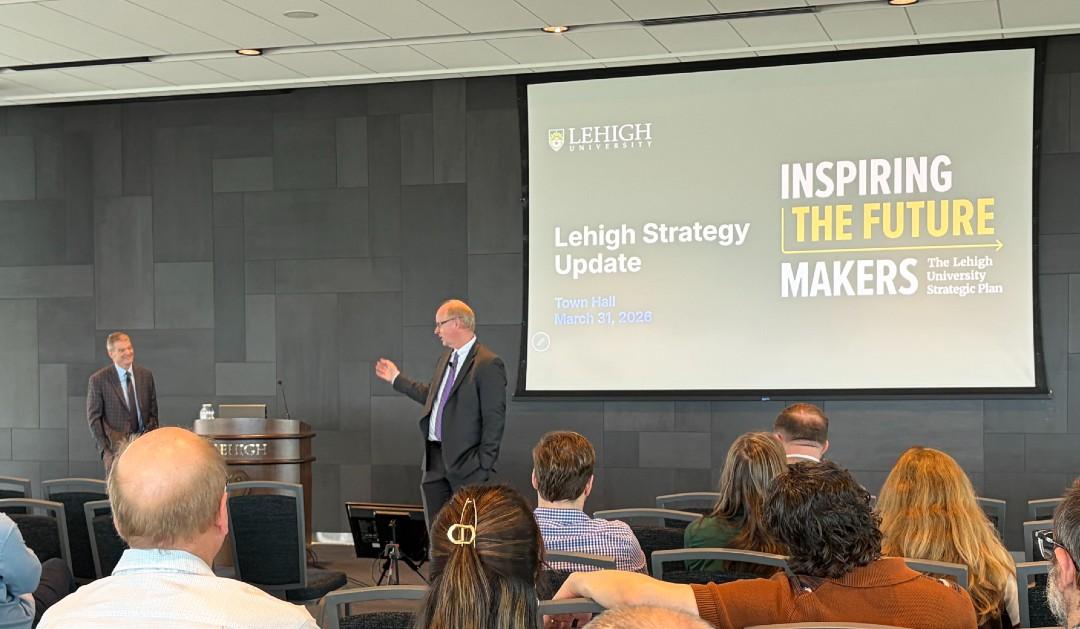
Speaker presenting 'Lehigh Strategy Update' to an audience in a conference hall.

Provost Nathan Urban, center, speaks to attendees at Lehigh's Spring 2026 Inspiring the Future Makers Strategy Town Hall.

Inspiring the Future Makers at Year Three: Lehigh Reflects on Progress, Prepares to Evolve Strategy for a Changing World

Getting your Trinity Audio player ready...

The Town Hall highlights momentum in student success, research and AI-driven innovation while signaling key shifts ahead as the university enters year four of its 10-year plan.

At the Spring 2026 Inspiring the Future Makers Strategy Town Hall, university leaders reflected on a year of measurable progress while emphasizing that the next phase of the Inspiring the Future Makers strategy will require adaptation, deeper engagement and continued community-wide commitment.

Opening the session, President Joseph J. Helble ’82 reinforced the purpose of the ongoing Town Hall series as a cornerstone of transparency and accountability. “We made a commitment to develop a plan that would be a living, breathing set of goals,” Helble explained. “It is the focus of our annual planning and our conversations and every single board meeting we have had over the last three years.”

Helble pointed to tangible outcomes across key areas of the strategy, including improved student outcomes, the launch of three university-wide research centers and growing momentum in educational innovation. He also underscored the increasing role of artificial intelligence across the institution. “AI is front and center of every conversation and we are integrating that intentionally into the strategy,” Helble continued. “That is essential to prepare our students and help this institution embrace these tools in appropriate ways.”

He noted additional signs of institutional strength, including a record applicant pool and continued progress toward the university’s $1.25 billion “Go Beyond” fundraising goal.

At the same time, Helble reaffirmed the university’s commitment to community and belonging, acknowledging recent campus challenges and the importance of addressing them directly. “It is incumbent on each and every one of us to make sure that every person on this campus is fully embraced, welcomed and supported for who they are, and knows they belong.”

Year Three Progress and Strategic Momentum

Mark Erickson, interim vice president for strategic planning and initiatives, outlined how the strategy is being actively implemented and continuously refined. “This is your strategy. It’s not Joe’s strategy, it’s not Nathan’s, it’s not mine. It’s ours. And it is an evolving strategy,” said Erickson.

Erickson emphasized a structured approach to execution, with 71 action items mapped across 10 initiatives this year. The majority of these are on track for completion within the year. Among the year’s accomplishments:

  • Expanded corporate and community engagement, including a new “front door” for industry partnerships
  • Launch of an AI readiness promise for students
  • Broader tracking of student retention across first, second and third years
  • Creation of a student advisory group to strengthen communication and engagement focused on our strategy

He also highlighted several signature initiatives gaining momentum, including Explore Lehigh, a program designed to help undecided students explore multiple academic pathways, which attracted more than 400 applicants for just 30 spots this fall. He noted continued progress on Mountaintop activation, including the first phase of opening forest areas for recreational use, as well as expanded community engagement efforts reflected in a significant rise in regional perception metrics, particularly in willingness to recommend Lehigh to others.

Looking ahead, Erickson emphasized that evolution of the Inspiring the Future Makers strategy is both necessary and expected. “The world has changed in the three years that we’ve been doing this,” Erickson pointed out. “As we prepare to move from year three into year four, part of what we want to do is think about our present strategy structure. What should look different as the world has changed, what can be combined, what should be added. The strategy will need to evolve based on how we answer those questions.”
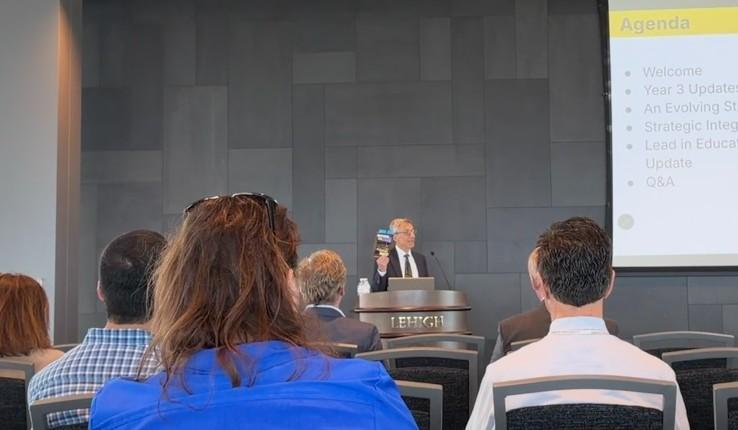
A man at a podium speaking to an audience.

President Joseph J. Helble ’82 reinforced the purpose of the ongoing Town Hall series as a cornerstone of transparency and accountability.

Research: Progress Amid External Headwinds

Provost Nathan Urban provided an in-depth look at research performance, noting both resilience and challenges. “The good news is we are submitting research proposals at a rate that would predict this year will be about the same or slightly ahead of last year,” said Urban.

However, he acknowledged a slowdown in research expenditures driven largely by delays and uncertainties in federal funding. “We are expecting that we will see a decline in research expenditures this year, not because proposals aren’t being submitted, but because decisions are slower and funding is not coming through at the same rate.”

Urban also pointed to shifting national priorities, particularly the growing emphasis on AI-driven research through federal initiatives, and stressed the importance of aligning faculty work with these emerging opportunities.

Despite the challenges, the university has seen notable successes, including growth in National Academy memberships and continued expansion of research infrastructure.

AI Integration and Academic Innovation

Artificial intelligence emerged as a central theme across all presentations, shaping operations, research and teaching.

Urban described efforts to embed AI across the university—from administrative efficiencies like contract review tools to student advising platforms and new guiding principles for ethical use.

He also highlighted a key insight from recent surveys stating students are ahead of us in terms of utilization. This gap is driving new investments in faculty support and course redesign, including AI-focused transformation grants.

Education Innovation: Clarity, Access, and Hands-On Learning

Dom Packer, vice provost for educational innovation and assessment and senior advisor to the vice provost for research, focused on the importance of clarity and intentionality in how AI and new teaching approaches are integrated into the classroom. “Students should not live in a world of ambiguity about how and when and why these AI tools should be used in a given course,” explained Packer.

Packer explored the underlying purpose in the unification of the Center for Innovation in Teaching and Learning (CITL) with the Office of Educational Innovation and Assessment, creating a “one-stop” support system for faculty.

He also highlighted early successes in data-driven educational interventions, including improved student outcomes in mathematics courses, and the rapid expansion of the FYRE (First-Year Rossin Engineering) program. “The goal is to get students much more involved in engineering quickly,” he explained, “by offering more hands-on, collaborative and experiential ways to learn.”

With plans to scale FYRE to all first-year engineering students by 2028, alongside new investments in facilities and faculty, Packer emphasized that innovation must remain both student-centered and outcomes-driven.

Looking Ahead

As the Town Hall concluded, a clear theme emerged: while year three has delivered meaningful progress, the path forward will require continued adaptation, especially in response to technological change and evolving external conditions. The next phase will not simply be implemented, it will be built collectively.

Leaders stressed that the Inspiring the Future Makers strategy is not static and that its success depends on active participation across the university.

Watch the Town Hall recording, learn more about Year Three Accomplishments and check out the Future Maker Grants for continued opportunities to move the Inspiring the Future Makers strategy forward.