



World Migratory Bird Day holds a special place in the heart of Katie Bui ’26. Before summer 2024, the Lehigh architecture and product design student didn’t know much about migratory birds, or even that a day existed to honor them.
That is until Deirdre Murphy, associate teaching professor of art in Lehigh’s Art, Architecture and Design (AAD) program, invited her to help design a public art installation for Washington College’s Center for Environment & Society.
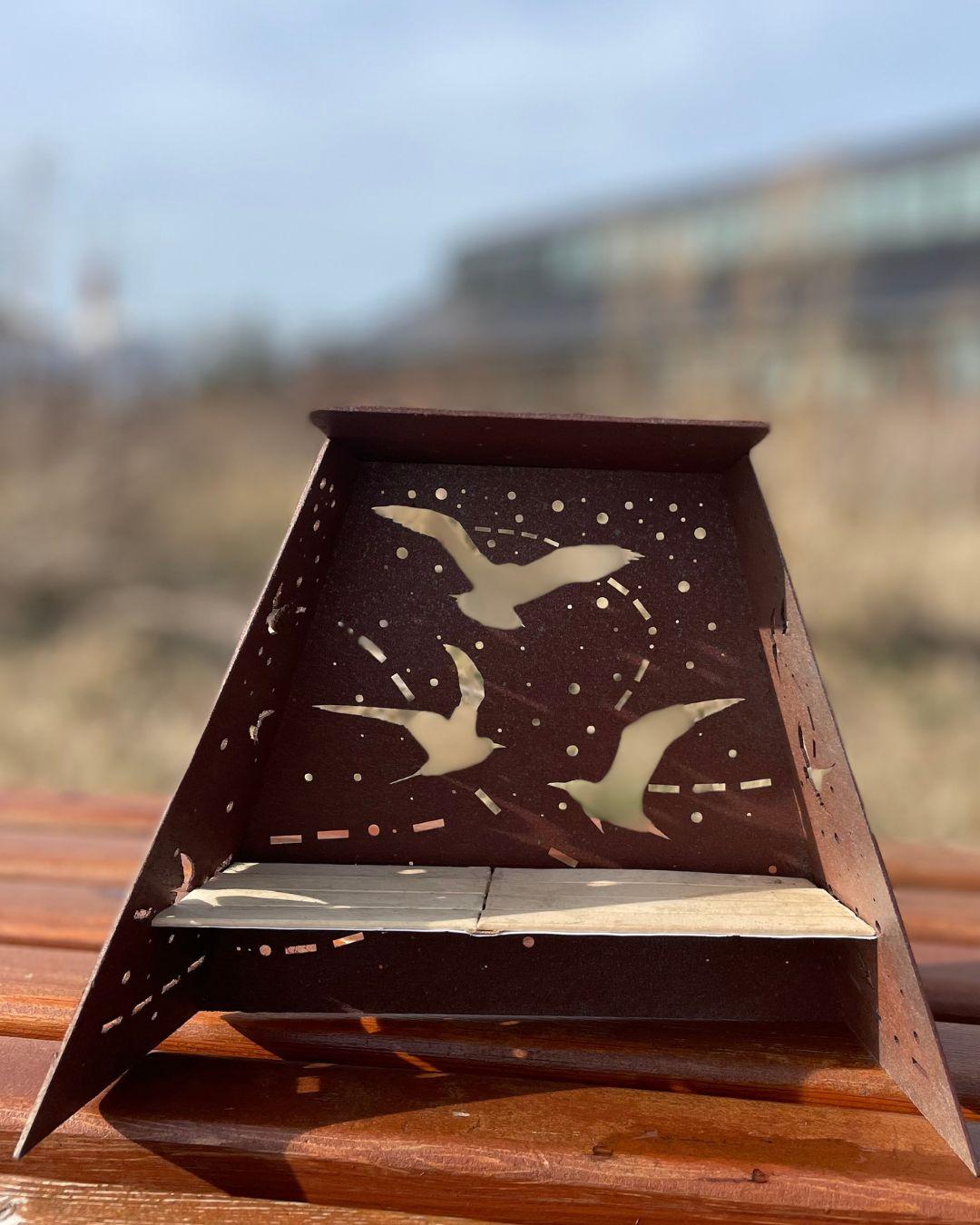
“Starting on this project as a sophomore, it confirmed that I was going in the right direction with my major,” said Bui. “Viewing the installation for the first time felt unreal. There was no way that the tiny model I created was the thing I was sitting in.”
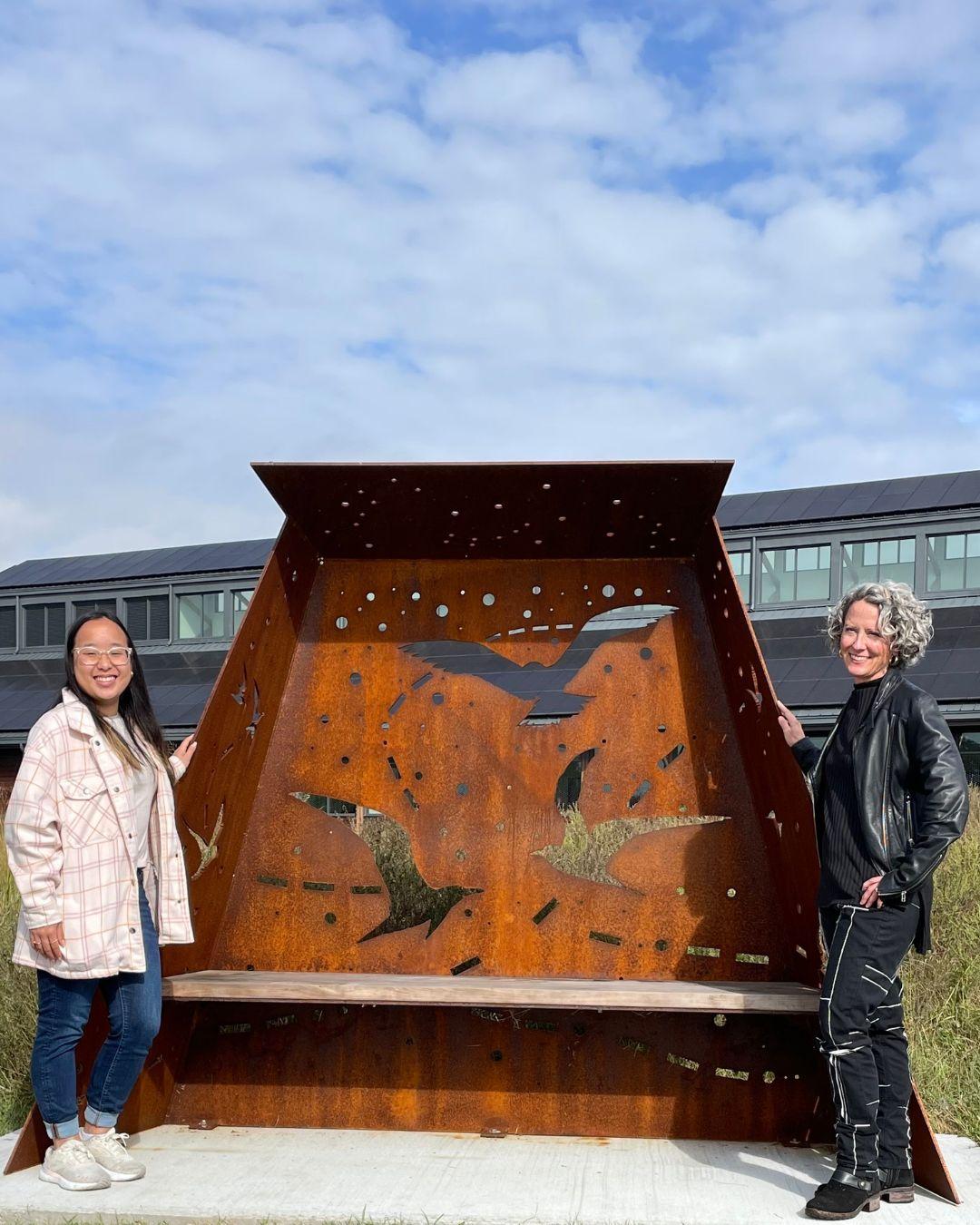
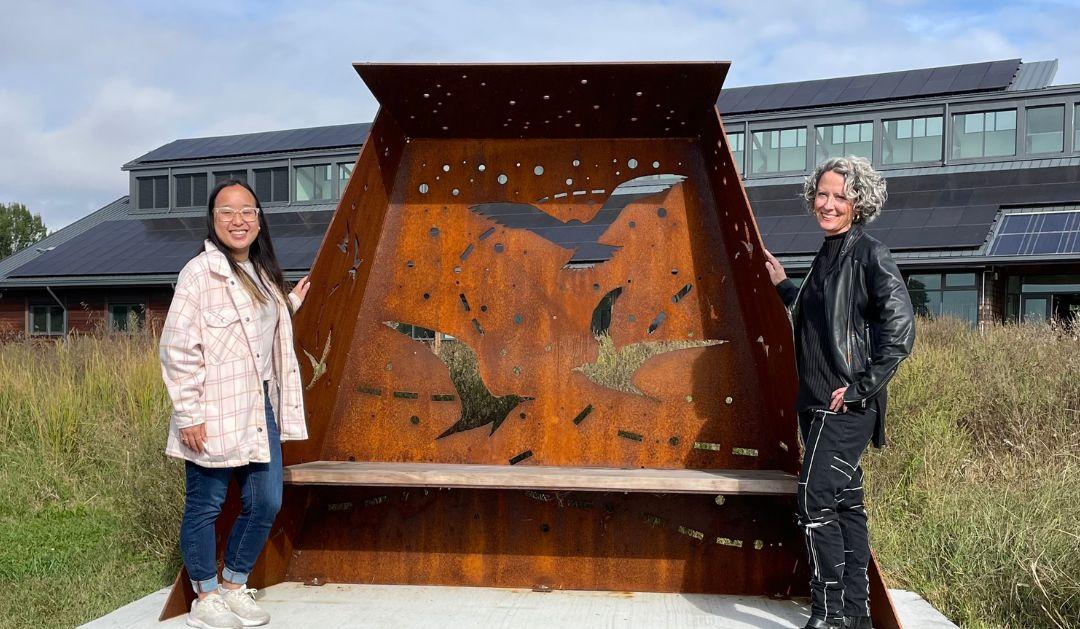
After securing an artist residency from the college’s Foreman Bird Branch Observatory (FBBO), Murphy and undergraduate research assistant Bui began working on Flyways, a steel sculpture etched with migrating birds that invites visitors to observe quietly and look skyward. Designed as both a bench and a bird blind, Flyways functions as a public installation that allows viewers to connect with the natural world right in their backyard.
The FBBO works to explore how sculptural viewing structures can support ecological observation while minimizing human impact on wildlife habitats. Bird blinds also act as an educational tool, empowering the public to learn about bird migration, climate change, habitat loss and biodiversity through a work of art.
Supported by a Dean’s Creative Arts Grant from Lehigh’s College of Arts and Sciences, Bui applied her skills in drawing and computer-aided design (CAD) modeling to help shape the sculpture: from scouting the Chesapeake Bay area site and creating the concept to fabrication and installation.
Their collaboration transformed Murphy’s residency into a hands-on learning opportunity that bridged classroom practice, real-world impact and allowed for a serendipitous twist.
Flyways would be installed within a landscape already shaped by another member of the Lehigh community.
Katy Hunchar ’03 M’05, principal and director of marketing and business development at the architecture and planning firm Ayers Saint Gross, helped design Washington College’s Semans-Griswold Environmental Hall, a Living Building Challenge–certified facility that houses the Center for Environment & Society. Overlooking the Chester River, the building now serves as the backdrop for the Flyways installation.
Bui and Hunchar met in 2024, when Hunchar travelled to campus with Ayers Saint Gross as a part of a larger presentation that introduced the firm to students. The occasion allowed Bui to show Hunchar the Flyways concept and the renderings she drew.
"The Semans-Griswold Environmental Hall is designed to embrace the Chester River and the land around it, and Flyways carries that spirit forward,” Hunchar said. “Seeing a current Lehigh student honor that connection so thoughtfully is very inspiring."
The convergence created a unique, full-circle moment: a current Lehigh student contributing artwork to a site designed in part by a Lehigh graduate, connected through a faculty mentor who made the collaboration possible.
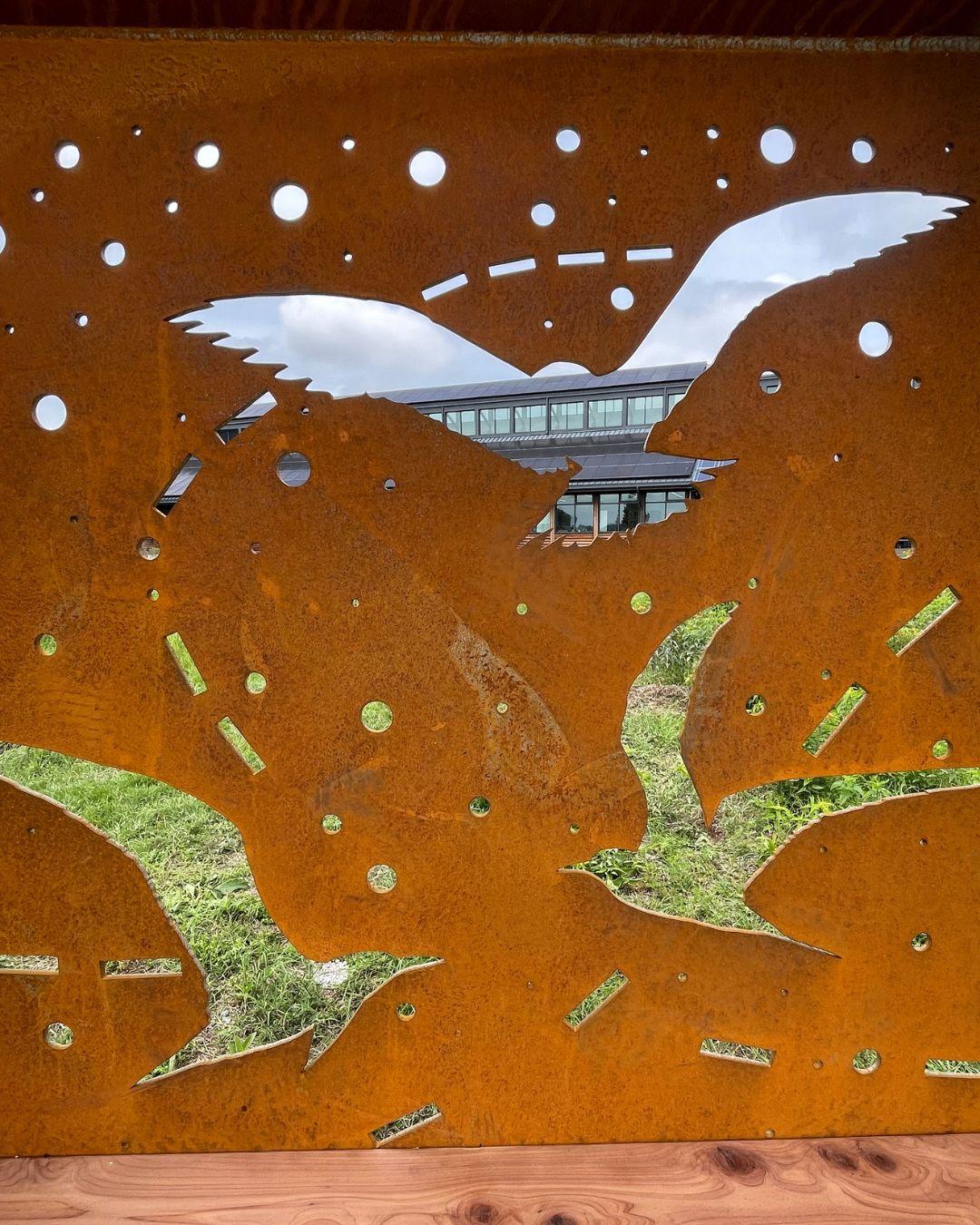
Flyways is unique in another way as well. It has a highly interdisciplinary nature, blending art, science and environmental education. Projects spanning multiple disciplines come with the opportunity for invaluable learning and collaboration. Murphy and Bui worked alongside scientists from the Foreman Bird Branch Observatory who selected two long-distance migratory species — the Caspian Tern and the Least Tern — to be featured in the sculpture, reflecting their seasonal journeys along the Chester River flyway.
Carved into the shade structure above are cutouts of constellations including Polaris and Cassiopeia, evoking celestial navigation used by both birds and sailors for centuries. The design allows visitors to consider movement across hemispheres and the interconnected systems that guide migration.
Over two months and over 20 renderings later, “there was a moment when everything just felt perfect,” Bui said. “Collaboration, working across disciplines and sustainable design are three things I’m passionate about as an emerging architect, and this project blended them together,” she added.
Constructed from weathering steel that develops a rust-like patina over time, the sculpture blends naturally into the Eastern Shore landscape. Seating elements crafted from locally sourced Eastern cedar reinforce the project’s connection to place and sustainability.
For Murphy, the project reflects the potential of public art to deepen environmental awareness while creating opportunities for budding designers.
“It was really wonderful to have Katie there through this project’s whole journey and to watch her grow from her first year at Lehigh,” Murphy added.
The two attended the sculpture installation ceremony on World Migratory Bird Day in October 2025, snapping photos to commemorate the collaborative project and their paths that have crossed once again. Like the migratory trek outlined by steel to reveal the sky, Flyways remains a living metaphor for the Lehigh community who will collide and intersect, wherever their next journey takes them.