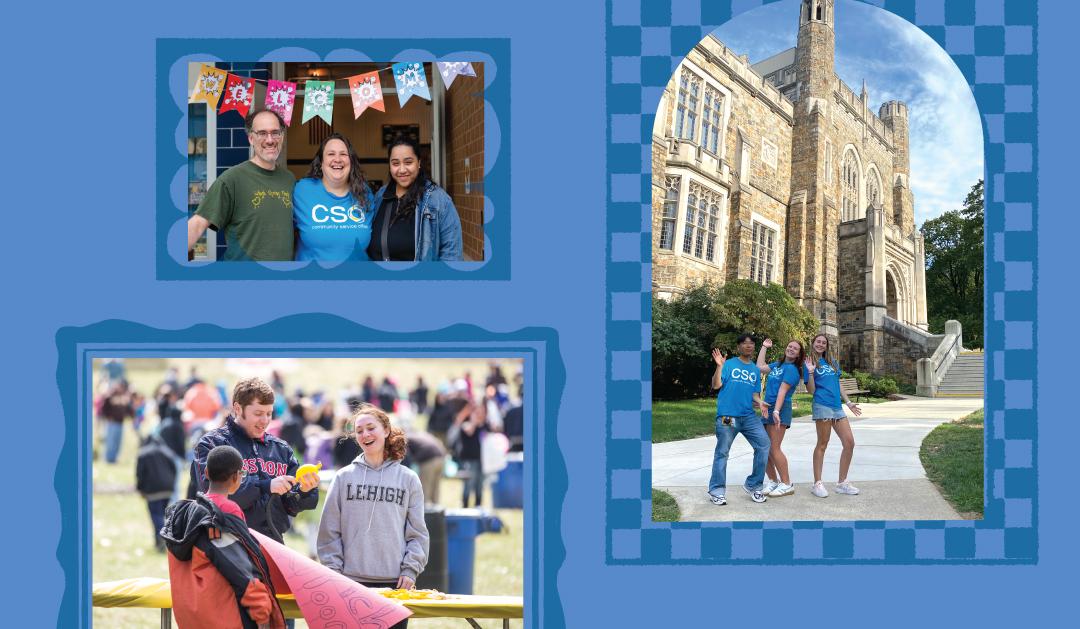
Collage of three photographs showing university students and staff at various campus events.

A Work of Heart: Fostering a Legacy of Service on the SouthSide and Across the Globe

Getting your Trinity Audio player ready...

As the Community Service Office celebrates 30 years, students, staff and alumni reflect on Lehigh’s dedication to community service, the lives it touches and connections that matter most.

Story by

Katie Clarke

Photography by

Christa Neu

The heart of the Lehigh experience is found within its community, which extends far beyond the classroom and South Mountain. While the rapid rise of technology, social media and artificial intelligence has changed how people access information, Lehigh students continue to find that the most meaningful moments happen through genuine, human connection.

“Community is what keeps people at Lehigh,” says Carolina Hernandez, assistant dean and director of Lehigh’s Community Service Office (CSO), which is celebrating its 30th anniversary this year. “It's that connection, to faculty, to friends, to each other. What keeps people here is feeling like you belong.”

Established in the fall of 1996, the CSO’s mission is to further develop students, faculty and staff as active citizens who value and contribute to the community by responding to community needs through action. Students can engage in purposeful service by volunteering during the school year, over breaks on SERVE trips or by tutoring local elementary and middle school children through America Reads/Counts.

Community is what keeps people at Lehigh. It's that connection, to faculty, to friends, to each other. What keeps people here is feeling like you belong.

Carolina Hernandez

When Hernandez joined the CSO nearly 25 years ago, the office operated in a storage room with five student coordinators and 20 tutors. Today, it has expanded into a vital campus hub with 25 student coordinators and 200 students who serve as tutors in the community.

Many of the CSO’s long-standing programs still anchor their work, such as Spring Fling, a one-day program developed with input from Bethlehem residents where children and families from community schools in Bethlehem are invited to campus for a carnival-like day of fun and education.

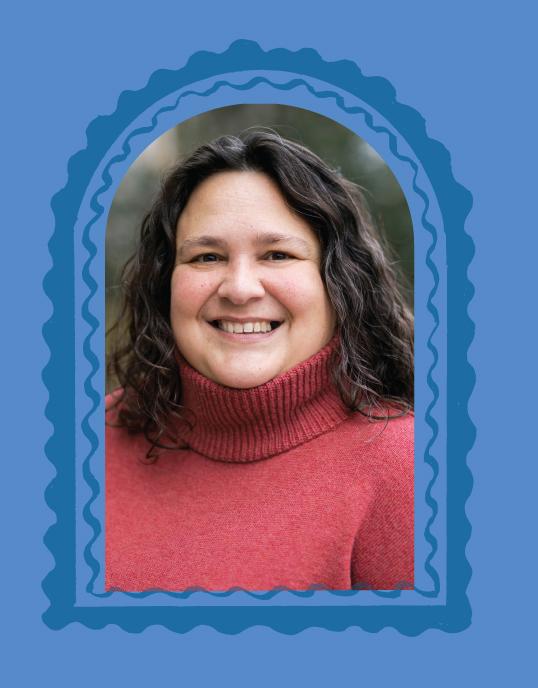
Photograph of a smiling woman in a red turtleneck, framed by a blue scalloped arch.

Another impactful program is the Great South Side Sale, which celebrated its 30th year in 2026. Donated items from student move-outs are sold at the annual event, which raised nearly $27,000 in June to support children’s programming in South Bethlehem through Donegan and Fountain Hill elementary schools and Broughal Middle School.

Evolving partnerships with the Bethlehem Area School District continue to enrich community schools, while weekly service at the Victory House remains a fixture for students as they help provide shelter and resources to local veterans.

Those programs did not emerge overnight. Hernandez emphasizes that community partnerships are built through years of trust and consistent investment. One recent moment made that impact unmistakable.

At the recent Student Access and Success First Generation Breakfast celebrating graduating seniors, Crystal Flores ’26 addressed the audience as the student speaker.

A Southside Bethlehem native, Lehigh’s students and services were part of Flores's education since elementary school. She remembers being in Reading Rocks, a program where Lehigh student-athletes tutored at Donegan Elementary. When she attended Broughal Middle School, she participated in the CSO’s homework club. It was that support, Flores says, that ultimately led her to feel confident enough to pursue higher education and apply to Lehigh.

“During my first year at Lehigh I was one of the CSO tutors,” Flores says. “This full circle moment was so important to me because I was able to motivate students to follow their dreams just as those before me did. I will always be grateful for the CSO.”

It’s moments like this, Hernandez says, where the outcome is not immediate, but makes the investment even more significant.

Community Service in Every Corner of Campus Life

When the CSO was established, “there was nothing but creativity and innovation,” Hernandez says. They set out to create a culture of participation and active citizenship.

Today, Lehigh students, faculty, staff and alumni are engaged in community service initiatives across the university and globe, from Greek life to the basketball court and everywhere in between.

While abroad in Negril, Jamaica, Landon Patoir ’28 took part in a global service initiative for his fraternity Delta Upsilon (DU), helping to construct a local school. It was an experience he says makes him feel “more inclined to do service work around the world.” His role as chapter vice president for philanthropy is one he takes seriously.

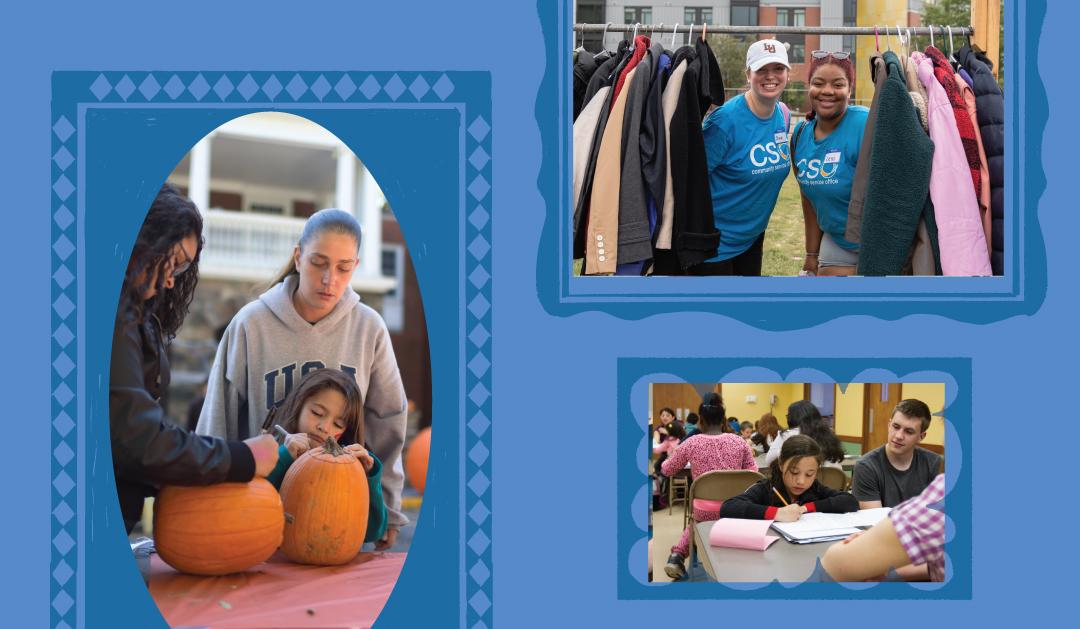
Photographs of volunteers carving pumpkins, organizing clothes, and tutoring.

“Being able to help people in person is one of the few things that still feels authentic to me,” Patoir says. “You don’t need to have help from AI or post it to social media to do service and it’s something that’s still ‘human’ in an increasingly technology-reliant world.”

In addition to global service, Patoir works alongside the CSO team for upcoming opportunities in Bethlehem so he can facilitate service experiences for DU members. His chapter has volunteered at the Grace Community Foundation Food Bank, the Young Women's Christian Association, New Bethany, Relay for Life and the Southside Arts District, among others.

DU averages nearly 150 hours of service per semester. Lehigh’s fraternity and sorority members raised a total of $82,277 for philanthropic partners and completed 11,074 service hours in the Bethlehem area from 2024-2025.

“In the community, we're one Lehigh,” Hernandez says. “And it's important for us to be aligned and on the same page. We’re making sure that we are going out and integrating the voices of our community partners.”

Being able to help people in person is one of the few things that still feels authentic to me. You don’t need to have help from AI or post it to social media to do service and it’s something that’s still ‘human’ in an increasingly technology-reliant world.

Landon Patoir ’28

Ella Stemmer ’25 M’27 participated in community service through her time as a former varsity basketball player. Stemmer served as a Community Outreach by Athletes who Care about Helping (COACH) co-captain beginning in her sophomore year of her undergraduate studies as a behavioral neuroscience major. Now as a graduate student in the Teaching, Learning and Technology program, she recognizes COACH as a “significant outlet to student-athletes.”

“COACH provides not just connection to each other, but to our greater community,” Stemmer says.

Student-athletes participating in community engagement have been a core part of the athletic program since 1991. The COACH program operates in accord with the National Consortium for Academics and Sport and reaches nearly 500 athletes who complete around 3,500 hours of service annually. Although the structure of the program has shifted in the past, Lehigh athletes have multiple opportunities per semester to serve the community, often as a mentor through their perspective as athletes.

Stemmer led groups of student-athletes through service at events like Wonderful World of Sports, a field day hosted at Broughal Middle School each semester. Lehigh Athletics also sponsored this year’s inaugural Lift for Hunger food drive where strength coaches lifted weights per pound of food donated.

“Some of the stories of the students I’ve worked with still give me chills to this day,” Stemmer says. “I think AI and the heavy tech involvement we have as a society have made me continuously stay involved in our community.”

Hernandez adds that current students and alumni alike, “might not even realize the imprint that [they] have left, but [their] legacy stands strong.”

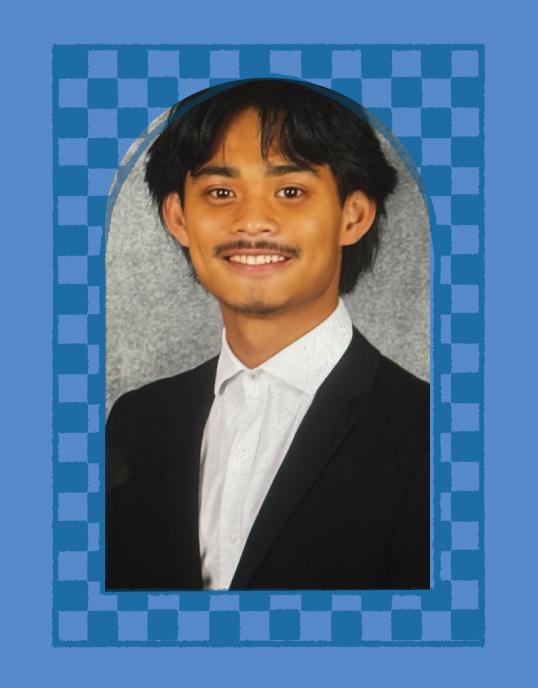
Photograph of a smiling young man in a black suit, within a blue checkered border.

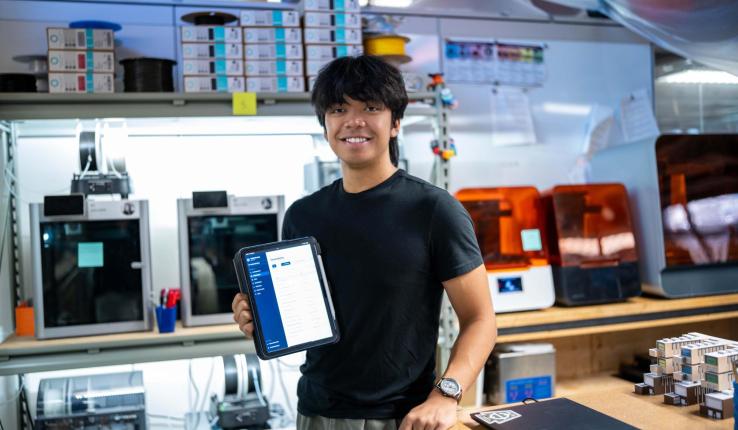
Students also leave their mark through community-based academic programs, like those in the office of Creative Inquiry. Joe Capuno ’28, a biostatistics and health data science major, has been a Lehigh Valley Social Impact Fellow for the last two years, working on a collaborative project called “Mapping for Change - Rethinking Walkability and Accessibility in Southside Bethlehem for All Residents.”

This project assesses the accessibility of the built environment for Southside Bethlehem residents, with Capuno and his teammates physically walking around the Southside and auditing what it’s like to walk the streets through capturing video. They watched out for sloping, green spaces, sidewalk conditions and whether people with different abilities can navigate the streets successfully. The team is now using Graphic Information System (GIS) technology to analyze their audits to provide visual, data-driven recommendations.

In the second phase of the project, the students also created a survey to gather input from the community on walkability and accessibility in the Southside. Through this community-driven approach, the research aims to identify areas for improvement and highlight disparities.

“As someone who wants to go into epidemiology, there’s only so much that you can do from just the numbers and data without the human context,” Capuno says. “Community engagement and my future career trajectory are closely intertwined."

Technology and Human Connection

Technology has made it easier than ever for students to be informed of community needs and opportunities to get involved. Students can now scroll through the CSO Instagram account and find new programs and opportunities or discover Southside nonprofits.

That same technology has produced a new commitment to connection, to creating friendships and getting out in the community. Students today may have reached an inflection point: an abundance of information and a renewed drive to act.

“Our students are incredibly informed, and that leads to motivation and action in very quick, responsive ways,” Hernandez says. “There is a heightened level of awareness of both community issues and global issues, and Lehigh students are not just aware of them, they do something about them. They show up and do the work on the ground.”

Maureen Phelan ’27 has been engaged in that work since her first days on campus. She was introduced to the CSO through PreLUsion, an optional three-day pre-orientation, as an incoming first-year student. Phelan chose the volunteer experience program from a handful of options, which took her to Donegan Elementary, Fountain Hill food pantry and Jacobsburg State Park.

“Being a part of the Community Service Office has definitely been one of the best experiences of my life at Lehigh,” Phelan says. “It gives me the chance to step beyond a screen, connect with people personally and make a direct impact.”

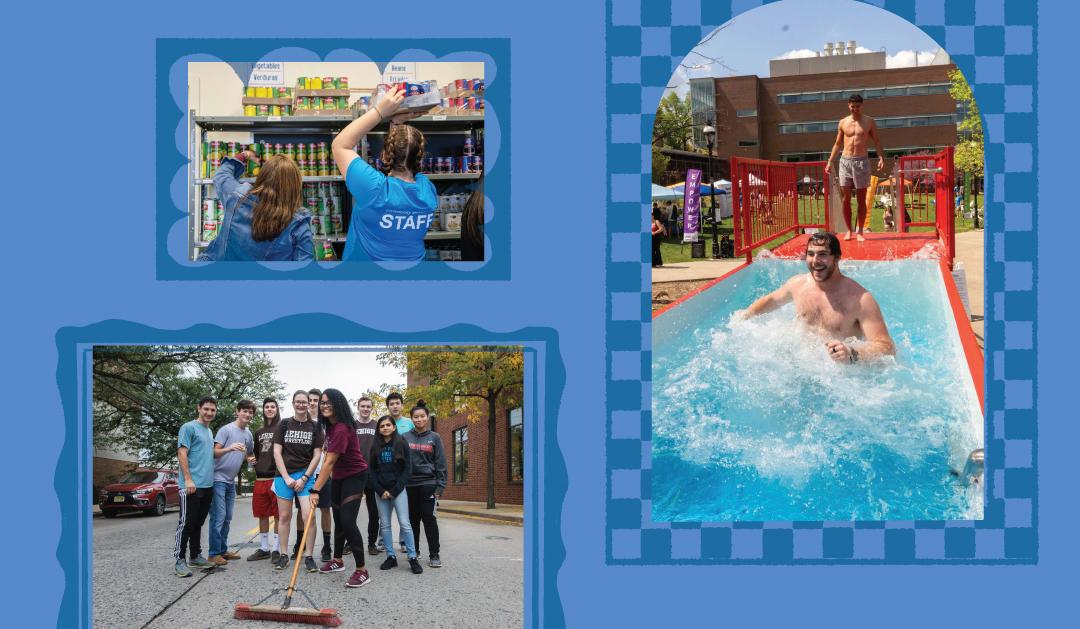
Collage of students volunteering at a food pantry, cleaning a street, and playing in a pool.

Phelan and Vanessa Elias ’27 met during PreLUsion and followed a similar path through the CSO. Now, they lead the same volunteer experience program that welcomed them to campus. Retitling it “Bridges to Bethlehem,” they offer incoming first-year students a refreshed take on volunteerism and public service focused on self-development and meeting real community needs.

“Technology makes it easier to become aware of the challenges affecting our communities and learn about opportunities to help, but meaningful action starts with understanding people and creating connections that technology alone cannot provide,” Phelan says.

As she prepares for a career in commercial banking after completing a summer internship at JP Morgan Chase, Phelan plans to keep her passion for service thriving by organizing and participating in corporate volunteer initiatives

Student Outcomes and Success in Service

Now at PwC, Arianna Morataya ’25 credits the skills she gained through the CSO as a homework club site leader to effective communication and project management.

“The homework club taught me how to balance my schedule, how to show up for the kids and be present even with academics on my mind,” she says. “The experience helped me grow and become a well-rounded person.”

Even with her full time job as an audit associate, Morataya does her best to be active in her community at home in New Jersey and in the office.

“Within the office, anytime there's a volunteering opportunity, I am one of the first people to look into it and send it to my teams to see if we could volunteer together,” Morataya adds. “I think it adds another layer of purpose and meaning to the work I do daily and it’s nice to have another outlet to be able to dedicate my skills and my time to.”

Next summer, Max Treonze ’28 will be interning with Deloitte, an accounting and consulting firm that stood out from other organizations due to its community service program for employees, he says.

When he isn’t pitching on the varsity baseball mound, Treonze’s next favorite thing is visiting Donegan elementary schoolers for afternoon sports activities. In Teonze’s first year on campus, fellow teammate Ryan Mullock ’26, now a management consulting analyst at Accenture, encouraged him to join COACH, where Mullock served as a co-captain.

Treonze says that the organization strives to “talk about academics with students, the importance of being motivated and staying positive through sports.”

Treonze attributes the gratitude he feels from service to a part of his work ethic.

“[Service] helps you express more gratitude, which in life I feel just leads to more success. I enjoy giving back, especially to the community of Bethlehem, which has given me so much already in the two years I've been [here].”

Nate Cable ’24 M’25, now a software engineer with Oracle, found purpose and community within the CSO that he says helped shape his future.

“Being a part of the CSO is like being a part of this larger family,” Cable says. “I don't think I would be where I am today without my time spent in the Community Service Office, learning and doing.”

A Lifelong Career in Volunteerism, Service and Nonprofit Leadership

Mary Beth Tully ’84 P’21 P’21 has spent her career demonstrating that service can be both a profession and a lifelong commitment. Through leadership roles in nonprofit and public policy organizations, she has focused on advancing optimal health access and strengthening communities.

At the United Hospital Fund, Tully’s governance role helps advance the organization’s mission to create an equitable health system for all New Yorkers, and leverages her rich understanding of public policy and how local, state and federal agencies work independently and together.
The way to really make an impact is to pursue those organizations and those opportunities that align with your passion.

Mary Beth Tully ’84 P’21 P’21

“The way to really make an impact is to pursue those organizations and those opportunities that align with your passion,” Tully says. “For me, it's about creating health equity in the five boroughs of New York City.”

A native New Yorker, Tully knew the community she wanted to serve long before stepping onto Lehigh’s campus. The CSO as it is today did not yet exist during Tully’s time on South Mountain. As a government major (now known as political science), she spent her senior fall semester interning on Capitol Hill, an experience that shaped her understanding of public policy on everyday lives.

“I fell in love with the interplay of public policy on real-life Americans,” she adds. “It wasn’t theoretical for me, it was the opportunity to understand how public policy can improve individual citizens and whole communities.”

Tully joined the Epsilon Psi chapter of Alpha Phi sorority, where she engaged in philanthropic work such as advocating for the chapter’s national cause, women’s heart health. Tully now serves as an adviser of Hofstra University’s Alpha Phi chapter, finding Greek life to be one of the many ways community and belonging are formed, as well as gaining leadership skills and opportunities students wouldn’t find in other settings.

After returning to her roots in New York City, Tully earned her Master’s of Public Administration at the Robert F. Wagner Graduate School of Public Service at New York University, developing a drive for health and healthcare policy.

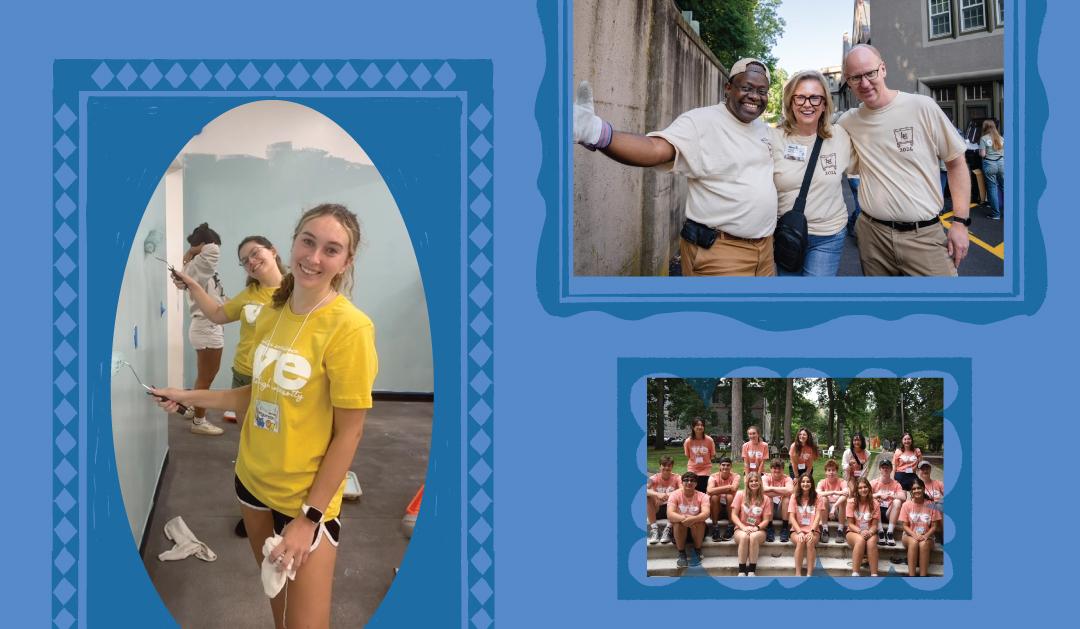
Collage of photographs showing volunteers painting and posing in group photos.

“The way to really make an impact is to pursue those organizations and those opportunities that align with your passion,” Tully says. “For me, it's about creating health equity in the five boroughs of New York City.”

A native New Yorker, Tully knew the community she wanted to serve long before stepping onto Lehigh’s campus. The CSO as it is today did not yet exist during Tully’s time on South Mountain. As a government major (now known as political science), she spent her senior fall semester interning on Capitol Hill, an experience that shaped her understanding of public policy on everyday lives.

“I fell in love with the interplay of public policy on real-life Americans,” she adds. “It wasn’t theoretical for me, it was the opportunity to understand how public policy can improve individual citizens and whole communities.”

Tully joined the Epsilon Psi chapter of Alpha Phi sorority, where she engaged in philanthropic work such as advocating for the chapter’s national cause, women’s heart health. Tully now serves as an adviser of Hofstra University’s Alpha Phi chapter, finding Greek life to be one of the many ways community and belonging are formed, as well as gaining leadership skills and opportunities students wouldn’t find in other settings.

After returning to her roots in New York City, Tully earned her Master’s of Public Administration at the Robert F. Wagner Graduate School of Public Service at New York University, developing a drive for health and healthcare policy.

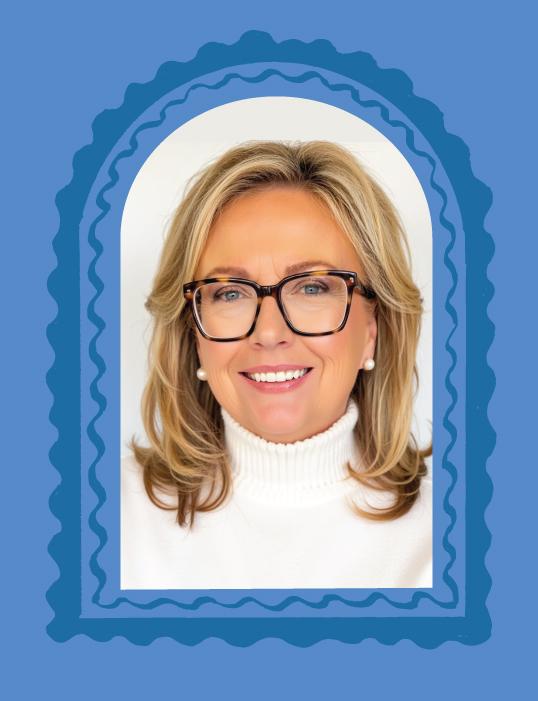
Smiling woman with blonde hair and glasses, framed by a blue scalloped arch.

These opportunities for local and global service expand students’ worldviews, encountering people and opportunities that make them more informed, more equipped, better educated and more compassionate. It fills students with gratitude, Tully adds, for the skills and talents they can share with others.

“There’s no greater love than that,” Tully says. “These students are future makers, they are good humans who are great problem solvers and they will demonstrate the legacy Lehigh creates.”

Back at the CSO, Hernandez sees Lehigh’s legacy reflected in the Lehigh seal, where the values of light, love and truth are represented through a rising sun and a heart resting on an open book.

“You can’t have that heart without community,” she says. “We have a responsibility to each other and the greater good.”

Leading with heart, she believes, is part of every Lehigh student’s story, and something that will always connect them.

Story by

Katie Clarke

Photography by

Christa Neu