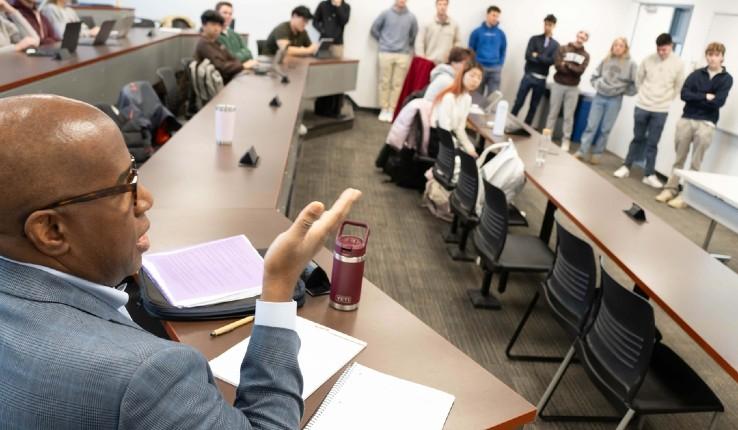
A professor sitting with students, all engaged in a discussion around a conference table.

Ozias Moore, associate professor of management, interacts with students during his Leadership in Organizations course.

Integrating Artificial Intelligence into Leadership in Organizations

Getting your Trinity Audio player ready...

Professor Ozias Moore used a Graduate Management Admission Council (GMAC) report to integrate AI into his management and leadership course.

Story by

Stephen Gross

Photography by

Christa Neu

When Aubrey Ide ’27 was a first-year student at Lehigh, she recalls the use of artificial intelligence (AI) not being welcome in her classes.

“It was frowned upon,” Ide said. “You would get in trouble for using AI.”

Now, just two years later, she found herself thanking Ozias Moore, associate professor of management, during an office hours meeting in November for integrating AI in his Leadership in Organizations (MGT 243) course.

Leadership in Organizations has been taught at Lehigh for six years and was created because recruiters said Lehigh students need more than an intro course in organizational behavior, which was the only related course offered at the time, according to Moore. He said recruiters expected students to enter organizations prepared to lead, manage and motivate teams—all the important things that leaders do. But for the Fall 2025 semester, Moore made a major update to the course.

He added an AI component.

Changing Course

When Moore begins thinking about what might be best to tweak or change in his courses, he often refers to a report compiled by the Graduate Management Admission Council (GMAC).

“It’s the leading organization that provides best practices and thought leadership for business schools,” Moore said. “It's an organization that really looks at what the important topics are emerging from the marketplace and recruiters, and what the important topics are for students when they're considering business schools.”

Among the report’s findings is something Moore has been keeping an eye on himself—student interest in hands-on AI classroom experiences. They not only want to know how to leverage AI for themselves, he says, but also want to know how they can apply it in their careers. He noted that the data directly reflects much of Provost Nathan Urban’s Oct. 30th “Becoming AI-Ready” email to students, faculty and staff surrounding AI use as a tool for students.

One of the main takeaways from the revamped course is that students complete the Microsoft and LinkedIn Professional Certification in AI for Managers program through LinkedIn Learning. The beginner- to intermediate-level program includes six comprehensive modules and “introduces AI concepts, tools and strategies directly applicable to managing people, projects and teams in today's workplace,” according to Moore.

A speaker gestures while addressing an audience in a classroom setting.

The certification not only shows employers students have current training in how to use AI in their industry as it continues to rapidly develop, but it also is a way to set Lehigh students apart from other job applicants that may not have these skill sets and certifications. Eventually, Moore expects more AI tools, such as OpenAI, to develop their own certifications and it will be a requirement for many job applicants, but for now it makes Lehigh students remain competitive in an evolving market.

He stressed that it’s not a course completion certificate, it’s an industry-recognized credential and something students can add to their resumes and LinkedIn profiles as well as reference in job interviews.

“The certification signals to employers that students have foundational competency in AI-driven management and leadership,” Moore said.

Moore’s own research on AI literacy examines how trust and AI literacy shape effective human-AI team collaboration—insights that inform his approach to preparing students for AI-integrated workplaces.

Another major aspect of the course is that students must create a personalized 12-month leadership development plan. It is based upon each individual and tailored to the industry or roles the student is interested in, including whether they see themselves working within the United States or abroad. The plan, which provides a roadmap for their early career, is also infused with AI competencies.

“Each person has their own set of areas of development, and so building that out is really important,” Moore said.

Throughout the semester, students also spend time building a business case around a leadership dilemma, culminating in capstone presentations the final week of class.

In addition, Ide said that she and her classmates have had in-class assignments regarding management or leadership perspectives where they have input scenarios into AI alongside group discussions.

While thanking Moore during their office hours meetings, Ide recalled her internship this past summer where the middle-market accounting firm didn’t embrace AI. Throughout the summer she said she thought about all the ways AI could have been implemented that would have made her work more efficiently.

When she searched for an internship for the summer of 2026, she made sure that was high on her list as she evaluated places to apply.

“I wanted a company that was making investments in AI and using it and Deloitte does exactly that,” Ide said.

Not only was she thrilled there is an AI component to the class, likely aiding her effort at next summer’s internship, she believes Moore has gone about its inclusion the right way.

“I think he does a great job implementing it and using it and exploring how we can use it as a resource in our class,” Ide said.

AI is certainly becoming more of a focus in all facets of people’s lives, but Moore made sure to rely strictly on data to inform the change he made rather than just include AI as a trend. His intention is that students will be fully prepared for the job market, making them more competitive and future-ready leaders.

“Am I just making change for change's sake?” Moore said he asked himself. “Or am I making sure that I am delivering a product that's matching the market that's important for my students to be able to have when they're going on interviews and making them the most competitive candidates as they're leaving the business school?”

Real-World Exposure

As someone who worked in the private sector before earning his Ph.D. and teaching, Moore believes it’s important to integrate both theory and real world application in the classroom. To help facilitate that, Moore invites guest speakers into his class, but with a twist from most courses. Instead of Moore selecting the guest speakers his class interacts with, he allows the students to select them. Students are separated into groups, which each research and then decide on a speaker for the class.

A total of six guest speakers attended over the course of the semester and included Lauren Maida ’17, global brand manager, Band-Aid and Neosporin at Kenvue; Daniel Long ’92, financial crime compliance, insider threat and conduct risk, Goldman Sachs; Kevin Cahill, Vandergrift family Lehigh head football coach; Ronald Carr MS’88, former co-owner of D'Huy Engineering, Inc. and senior structural engineer and consultant at Clough, Harbour & Associates (CHA) Consulting; William McKoy, senior vice president, chief financial officer and chief operating officer at Columbia University Irving Medical Center; and James Maida ’85 P’17 P’19, CEO, president and co-founder of Gaming Laboratories International, LLC and a Lehigh trustee.

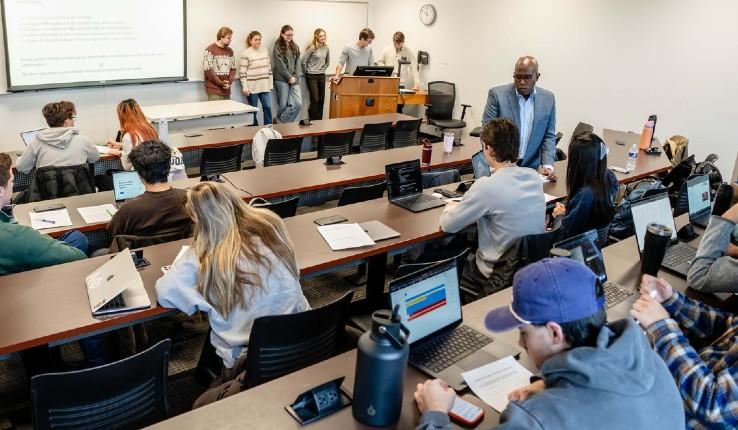
Students seated at desks in a classroom, with some presenting at the front.

Ide’s group was responsible for landing McKoy.

“We thought he would be a great person because of the recent federal cuts for medical budgets,” she said. “We thought it was super relevant. He was dealing with adversity and it was interesting to hear him speak about how he’s managing his leadership during this time.”

Ide said she felt she was more engaged with the guest speakers than she normally would be since they picked them and came up with questions for them. She said they also had a lot of group discussions regarding what exactly they wanted the speakers to address when they arrived.

The speakers provided real-world exposure across a diverse range of industries and just like the class, five of them were able to share how they were actively navigating AI adoption in their organizations. But even Cahill, who hasn’t fully integrated AI into his role as a football coach, was able to add to the discussion. While much of his discussion centered on how you motivate a team that has been underperforming to change their performance trajectory, Moore said Cahill acknowledged his need to embrace AI and be more aware of it in his first head coaching job.

Rapidly Changing

Overall, Moore said updating his course is important, and necessary, for staying current in regards to what is happening in industry.

ChatGPT, which Moore utilizes as a tool in class, marked three years since its public launch during the semester. So much has changed with attitudes around its use, as well as the ability of AI itself, in that short period of time. And in another three years or so, Moore believes the conversation again will completely change from where it is right now. He also sees AI being embedded across all classes and universities.

“Initially, a lot of the schools took it as something that they viewed as this negative, cheating tool, and people didn't see the strategic need for it. The necessity for the skills around integrating AI into curriculum and pedagogy, etc.,” Moore said. “But that pendulum has shifted. … It's super exciting to think about, we're living a business case.”

Story by

Stephen Gross

Photography by

Christa Neu