High-Q Planar Transformers for Data Center Energy Efficiency

Getting your Trinity Audio player ready...

Lehigh professor Zhang, alongside PhD candidate Peng, pioneer a high-efficiency Transformer for 380V-to-48V conversion, enabling the next generation of AI data center power infrastructure.

The Power Challenge in AI Computing

The digital age is defined by the explosive growth of data centers, vast engines of computation that power everything from social media to scientific discovery. At the heart of this revolution—particularly with the rise of Artificial Intelligence (AI) applications—lies a fundamental bottleneck: power. The premise is simple: AI runs on computing and computing runs on power. As these computational environments grow denser, packing more processing might into smaller spaces, the demand for energy is soaring. This intensification is significant, as data center electricity use is projected to double by 2030. This renders traditional power architectures obsolete, creating an urgent need for a new design that can keep pace with AI's seemingly endless appetite for electricity.

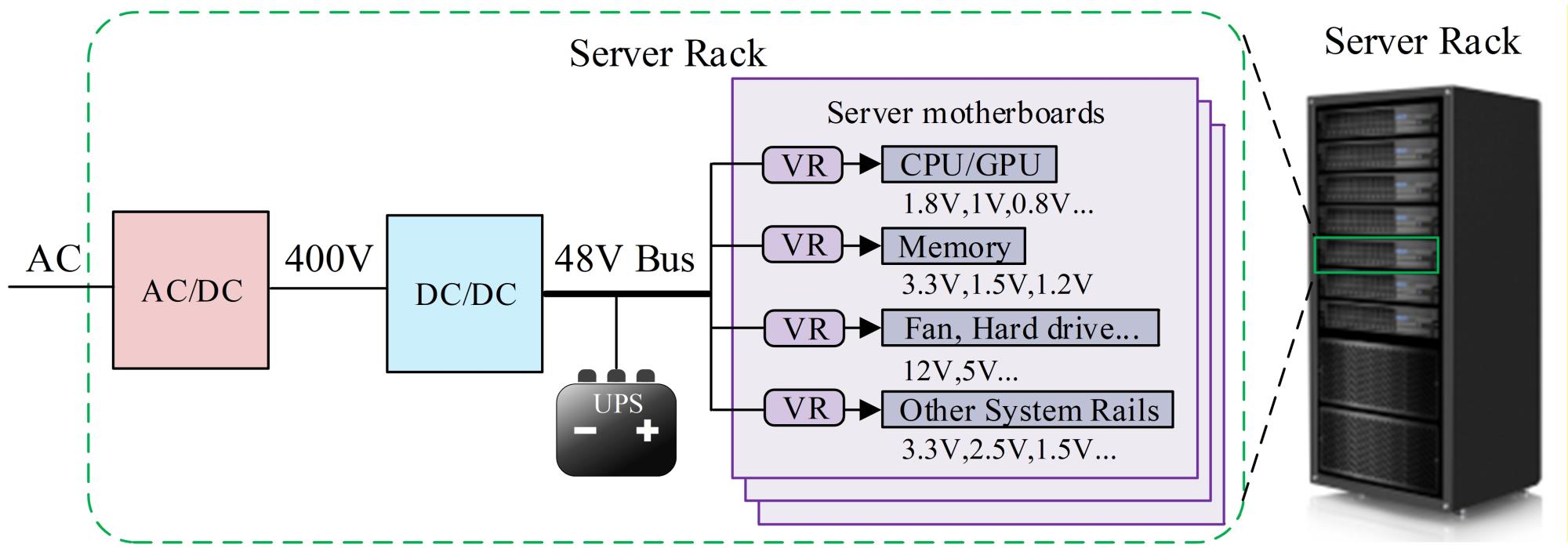
Current systems often involve multiple stages of voltage conversion, resulting in energy loss at each stage. Researchers focused on creating a more direct and efficient power supply: a High-Efficiency 380V-to-48V LLC Converter. This conversion ratio is essential for the emerging 48V bus power architecture in data centers, which is designed to minimize overall power loss across the facility.
Designing the Heart of the Converter

The key to achieving high efficiency in a power converter is in its passive components, specifically the inductor/transformer. The researchers' core innovation centers on the belief that Q matters—meaning, a higher Quality factor (Q) in the magnetic components leads to lower power loss.

They designed a new kind of transformer called a High-Q Planar Transformer. Instead of bulky, traditional wire-wound components, planar transformers are built using flat Litz windings allowing for better thermal performance and higher-frequency operation.

The team explored and tested multiple winding configurations for both the primary and secondary stages of the transformer to achieve the highest possible Q factor. Their design goal was to minimize resistance and leakage inductance, which are the main sources of power loss.

Furthermore, by leveraging Maxwell-simulated magnetic field analysis, they were able to precisely model the flux path within the ferrite plates and windings, validating that their proposed planar magnetic core structure was optimally designed for minimum energy dissipation.

Achieving Near-Perfect Efficiency

The success of the research was confirmed through rigorous testing of the implemented LLC converter.

The experimental results showed a significant achievement: the converter delivered a 97.2% efficiency at a 3.5 kW output. This high efficiency is supported by the achievement of stable soft-switching waveforms, a crucial condition that minimizes stress and loss on the power electronic switches. This is a critical result, as efficiency gains in data centers have a massive impact on operating costs and environmental footprint.

By demonstrating the stable operation of the converter and validating their high-Q planar transformer design, the team provided a critical technology solution. Their work delivers a compact, low-loss, and high-efficiency power supply essential for the next generation of high-power-density AI and cloud computing infrastructure.

Diagrams illustrating server power supply systems and configurations.

Emerging 48V bus power architecture in data center

The Future of Energy-Efficient Data Centers

The development of this high-efficiency, high-power-density 380V-to-48V LLC converter represents a major step toward making the next generation of AI-enabled data centers more sustainable and cost-effective. By validating the practical application of the high-Q planar transformer design, this research provides a clear path for the industry to adopt the 48V power architecture, leading to overall system efficiency improvements and a reduction in the operational carbon footprint of computing infrastructure. Future research will focus on further increasing the power density and exploring advanced thermal management techniques to integrate these high-performance converters into increasingly compact server racks.

Acknowledgements: Dr. Fei Lu, Dr. Yue Wu, Haonan Song, Yucheng Shen, Zihao Xin, Yan Zhang, Thierry Ahishakiye

This research was presented as part of the Innovating Energy and Water Solutions for Tomorrow's AI Data Centers Symposium hosted by the Center for Advancing Community Electrification Solutions (ACES) in October 2025.

Generative AI was used to organize this story, based on data and information presented in a research poster. It was reviewed and edited by faculty and communications staff.