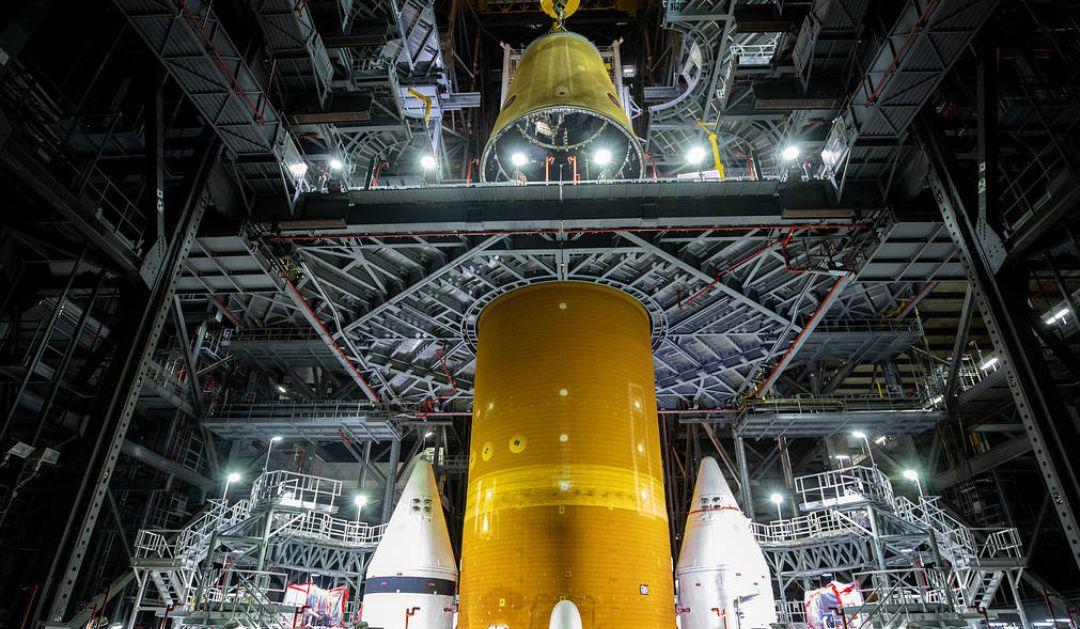
Photograph of a massive orange rocket core stage being assembled inside a hangar.

Detailed view of the Artemis II rocket.

From Lehigh to Liftoff: Mark Riddle ’87 on Creativity, Engineering and Working on Artemis II

Getting your Trinity Audio player ready...

Riddle’s interdisciplinary education at Lehigh led him to engineer the launch of the Artemis rocket.

Story by

Katie Clarke

Photography by

NASA Media Relations

Mark Riddle

In the days leading up to the launch of Artemis II, NASA’s first crewed lunar flyby in 50 years, many people wondered what it’s like to work for NASA and witness spaceflight firsthand.

That daydream was a reality for Mark Riddle ’87, an operations engineer supporting Amentum—NASA’s largest prime contractor at Kennedy Space Center—who helped prepare, validate and verify the umbilical systems that helped launch the Artemis rocket.

On April 1, millions watched the launch of Artemis II, uniting the country in a historic moment. At the John F. Kennedy Space Center in Merritt Island, Fla., Riddle was in a control room near the Vehicle Assembly Building (VAB) monitoring the Space Launch System (SLS) rocket preparing to lift off from platform 39B.

The umbilical systems he worked on were critical in providing power, fuel, air and signals to the rocket until it first lifted from the ground.

“It’s not just math and equations,” Riddle says. “There’s a lot of imagination that makes this happen.”

A Creative Foundation at Lehigh

Riddle has a knack for blending his interests. When he came to Lehigh to pursue a degree in electrical engineering, he dreamed of a career in music production: blending arts and sciences, the technical and the creative.

The value of an interdisciplinary education is something he’s carried from Lehigh classrooms throughout his career, which instead of landing in rock and roll, secured him a spot near the launchpad of one of the most ambitious space missions in decades.

In high school, Riddle developed an interest in music electronics—stereos, guitar amplifiers, synthesizers—and began playing guitar. As a Lehigh student, he was drawn as much to sound as to circuits and earned both an electrical engineering degree and a minor in music.

Electrical and computer engineering professor Carl Holzinger '56 MS'57 Ph.D.'63, known to students as “the Zinger,” left a lasting impression, encouraging Riddle to think beyond formulas and into the artistry of engineering.

That mindset was reinforced by other mentors, including electrical engineering professor Doug Frey ’73, MS’74, Ph.D’77, whose interest in music and amplifiers mirrored Riddle’s own.

Together, those experiences helped shape a broader perspective about open-mindedness and creativity that Riddle says has been essential throughout his career.
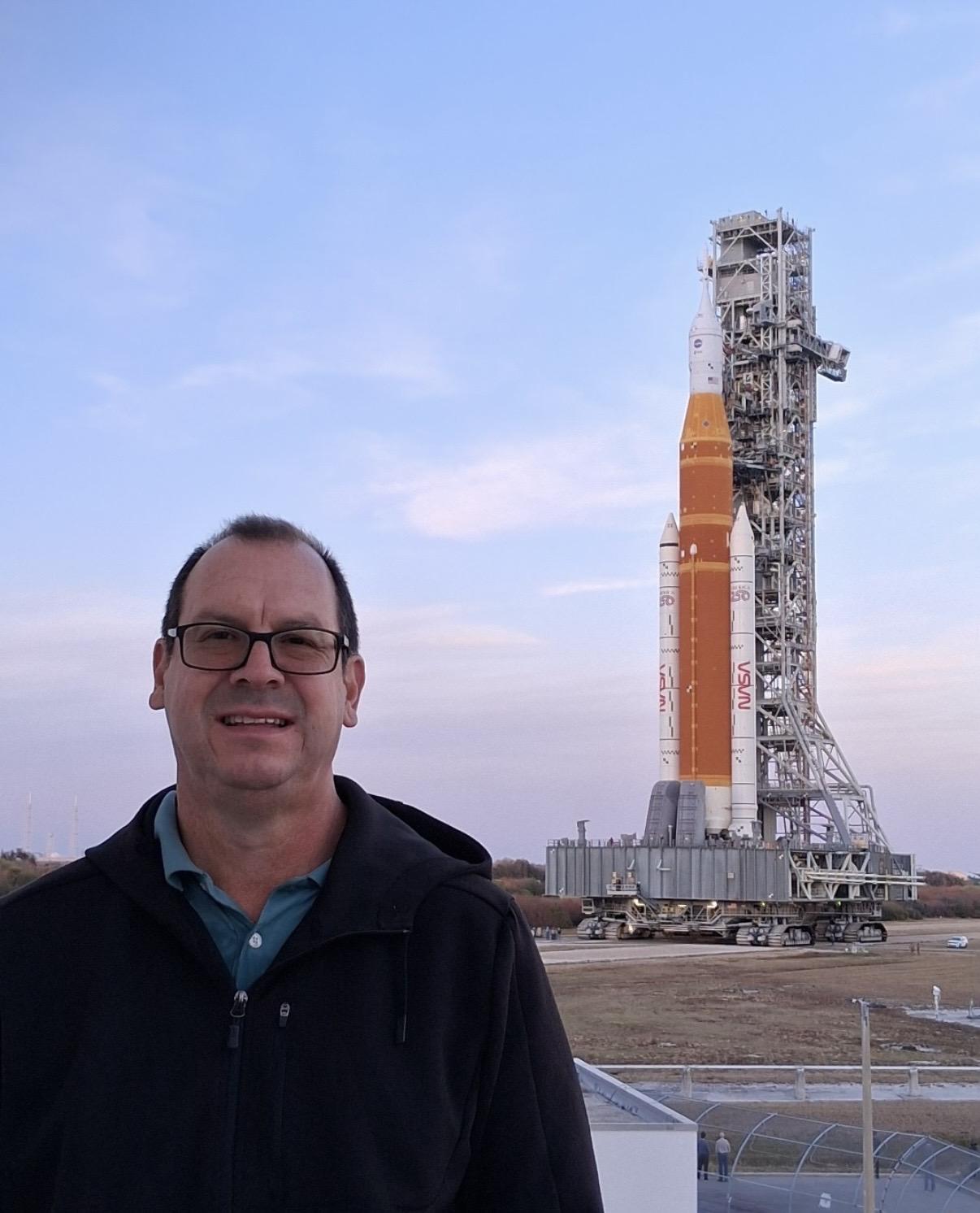
Photograph of Mark Riddle with the SLS rocket on its launchpad in the background.

Riddle in front the SLS rocket with the launchpad in the background.

After graduating, Riddle launched his career at the Philadelphia Naval Shipyard, where he worked on testing and refurbishing massive aircraft carriers like USS Independence (CV-62) and USS Kitty Hawk, as well as guided-missile destroyers USS Scott and Kidd.

“Lehigh teaches you how to think. The deeply layered learning environment at Lehigh has really helped me succeed in the diverse world of technology, science and engineering,” he says. “An aircraft carrier is like a mini city. There are so many different systems working together.”

The work was meticulous and, at times, tedious. Riddle was testing equipment, collecting and analyzing data and documenting results. This foundational experience introduced him to the kind of large-scale, interconnected systems that would define the rest of his career.

Over the years, Riddle moved across industries, from chemical processing to environmental monitoring systems, often working at the intersection of disciplines. Though trained as an electrical engineer, he found himself navigating mechanical systems, chemical processes and industrial operations.

“Integration is the key to mission success,” he says. “Every system is linked, constantly monitoring and backing each other up. That redundancy is critical for safety.”

Supporting NASA’s Artemis II Mission Through Umbilical Systems Integration

Roughly three years ago, Riddle was contracted through Amentum to perform critical systems work in support of Artemis II. Using his creativity and multidisciplinary approach to solve problems, he navigated the pressure, nerves and responsibility of building a system that would launch real people into the atmosphere.

“My biggest challenge was acceptance,” Riddle says. “Accepting that there was no way that I was going to be able to learn everything compared to others who have been working with NASA for 30 years. The best lesson is to concentrate on each moment and the small things you can do.”

On the floor of the VAB in the months leading up to the launch of Artemis II, he met the astronauts flying in the Orion spacecraft. The 600-plus people working in the VAB on those days would gather around as the astronauts took turns speaking at a podium.

“They were always so supportive,” Riddle says. “They're always so thankful to the engineers, the technicians. They depended on us to get it right the first time.”

Riddle didn’t realize how deep his involvement would be, but notes that he “was right in it—working on the systems that actually support the rocket.”

His focus is on umbilical systems, the critical connections that supply power, fuel, air and data to the rocket while it stands on the launch pad. In the final moments before liftoff, those systems are still actively supporting the vehicle and providing what Riddle describes as something close to life support.

“It’s like filling your gas tank,” Riddle says. “You can’t just drive off with the nozzle still in.”

At T-zero, what Riddle calls “first motion,” the rocket begins to rise and the umbilical connections must be released cleanly and precisely.

“Once it starts moving, that’s it,” he says. “You can’t stop it. Everything has to work exactly as designed.”

The Pressure and Precision of a NASA Launch and Splashdown

The work leading up to that moment is defined by repetition and rigor: testing, retesting and constant monitoring. In the hours before launch, Riddle and his colleagues are stationed at their systems, watching data streams, listening to communications from the control room and keeping a close eye on every signal.

“At the same time, you’ve got the NASA feed up. You’re multitasking but your focus is on making sure your system performs exactly as it should.”

Even with years of preparation, uncertainty is ever-present. That responsibility is shared across thousands of engineers, technicians and specialists working across NASA centers and partner organizations, all contributing to a single launch.

On launch day, Riddle was on-site, supporting operations as tens of thousands gathered to watch. When the rocket finally lifted off, the moment carried less celebration than expected.

“It was an overwhelming relief,” he says.

Trust and responsibility form the basis of Riddle’s work. Inside the Rocco A. Petrone Launch Control Center at Kennedy Space Center, a wall of mission plaques tells the story of decades of human spaceflight. Each plaque includes two markers: one for launch and one for landing.

The plaques for Space Shuttle Challenger and Space Shuttle Columbia remain unfinished, serving as somber reminders of missions that did not end as planned.

“It’s why you follow every procedure to a tee,” Riddle says. “No shortcuts.”

As the crew returned home, Riddle watched the splashdown from his living room. He followed the livestream for hours, exchanging messages with family members across the country. He never stopped pacing until the crew landed safely in the ocean.

Why Creativity Matters in Engineering and Space Exploration

Riddle hasn’t lost sight of the creative spark that first drew him to engineering. He still plays guitar and still sees connections between music, problem-solving and the work he does today.

It’s a lesson he carries forward, and it’s one he offers to students who hope to follow a similar path.

“Be open-minded. Be creative. Learn something outside of science. A well-rounded person is the one who’s going to succeed.”

Even in the most complex systems, whether on aircraft carriers or on a rocket bound for the Moon, success depends on more than technical precision alone. It begins, as it always has, with imagining what is possible.

Story by

Katie Clarke

Photography by

NASA Media Relations