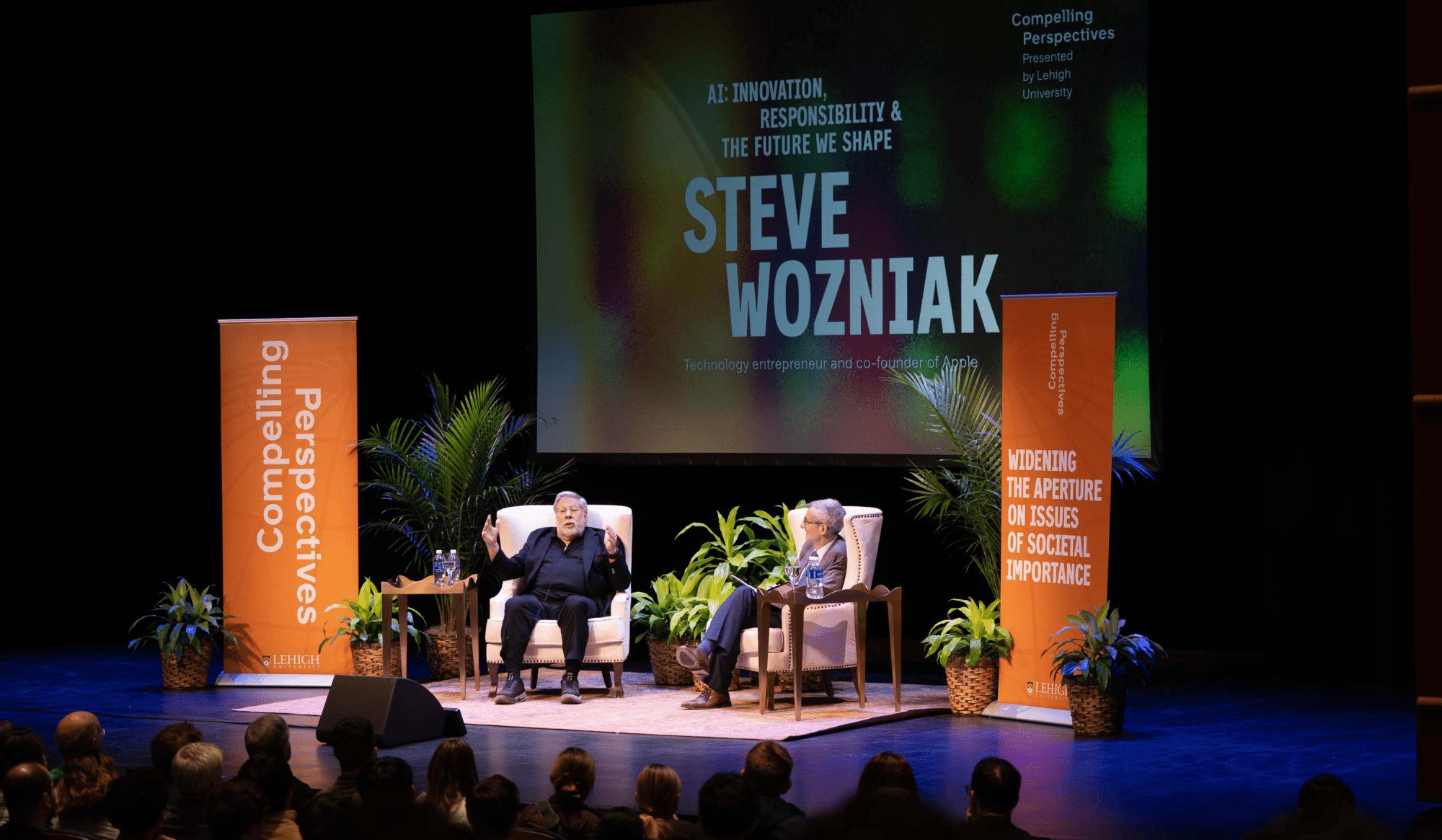
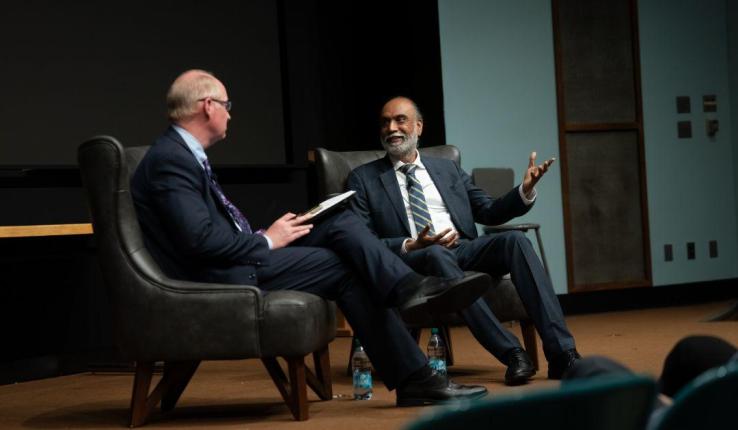
Steve Wozniak speaking on stage, seated with President Joseph J. Helble, surrounded by an audience.

Steve Wozniak Discusses Apple, AI and Pranks as Compelling Perspectives Speaker

Getting your Trinity Audio player ready...

The Silicon Valley icon, technology entrepreneur and philanthropist advocated for AI regulation and said he’s proud of “not selling out” as the series’ third and final guest of the academic year.

Story by

Stephen Gross

Photography by

Christa Neu and Jordan Gruber

Before he co-founded Apple with Steve Jobs, Steve Wozniak was brought into Atari by Jobs to help design the arcade game Breakout using as few chips as possible.

Over four days with little sleep, as Wozniak worked, he wondered “Wouldn’t it be neat if someday these arcade games were color?”

He said he relied on his analog electronics experience, drawing off how he knew color TVs worked, and combined it with his knowledge of binary code using 4-bit number to produce 16 different combinations, each a different color on a television.

Not only did Wozniak’s discovery lead to the Apple II computer—the first time arcade games were ever color and a product that would be the company’s only revenues for its first decade—but also was the reason Apple’s first logo was six colors.

The third and final speaker in the 2025-26 academic year’s Compelling Perspectives Series, Wozniak spent nearly 45 minutes Thursday evening engaged in conversation with Lehigh President Joseph J. Helble ’82, sharing stories, such as his work on Breakout, that highlighted his passion for electronics. The Silicon Valley icon, technology entrepreneur and philanthropist participated in a wide-ranging discussion that touched upon his early life in Silicon Valley, engineering career and artificial intelligence (AI).

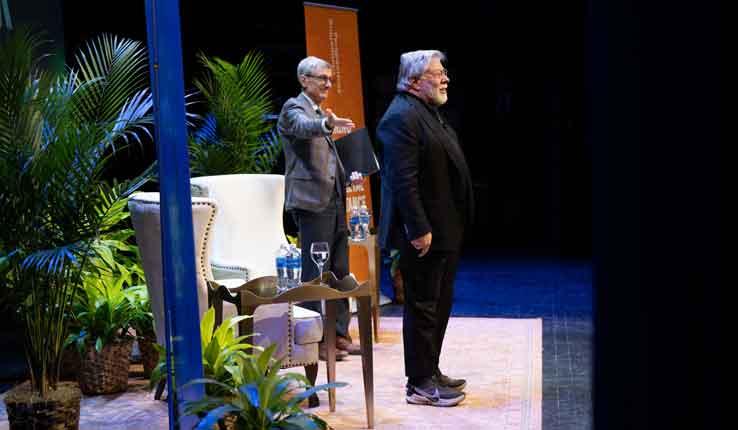
Two speakers stand on stage, surrounded by greenery and facing the audience.

Steve Wozniak, in a conversation with Lehigh President Joseph J. Helble ’82, said he's most proud of being recognized "for being a genius of my designs from other engineers" and that he didn't get super rich and "sell out."

Despite his rockstar engineer status, Wozniak’s first words of the evening made clear his main wish was to be an engineer, not to become famous.

“I never sought to be an icon, to be known, have any notoriety at all,” he said. “It just happened.”

While he didn’t seek fame, just before an audience Q&A that allowed attendees to ask more than a half dozen questions closed out the evening, Wozniak did expand on what he’s most proud of in his life.

“I'm proud of being recognized for being a genius of my designs from other engineers, that's important,” he said. “I’m also very proud of the fact that I didn't sell out, I didn't get super, infinite rich and change.”

He explained that he gave away his Apple wealth, making sure those that helped inspire him in high school at his computer club received millions of dollars in stock and that he sold his pre-IPO stock to early Apple employees, who “all made a house out of the deal.”

Helble kicked off the conversation by asking Wozniak about growing up in Silicon Valley and Wozniak described his housing development in between fruit orchards that consisted of apricots, cherries and plums.

Known for his pranks—something he prides himself on—Wozniak shared how one of the mayonnaise jars full of little parts, such as switches, that he and other kids in the neighborhood had growing up was used to identify him after some of his mischief.

Helble, who said he wasn’t going to touch that topic, was now curious and pressed Wozniak about the prank.

Wozniak explained he put a metronome in his friend’s locker before heading off to his last final for the quarter. Although after placing it, he didn’t think it was very loud and assumed his friend wouldn’t even hear it. Upon checking after the final, the locker was empty.

Later, his guidance counselor found him and relayed that the vice principal was looking for him.

“I was thinking they’re going to give me a math award,” Wozniak said.

Instead, cops walked in with a big box that had wires hanging out of it. He sat with two cops, the vice principal and the dean and listened to the principal describe how he heard the ticking sound.

“He opened it up and clutched it to his chest and ran out to the football field,” Wozniak said. “And I had to cough to hide my laughter because I had a switch on a little piece of tin foil. When you opened the locker, it changed the resistor and the ticking sped up. A normal prank is for normal people. I went a little further.”

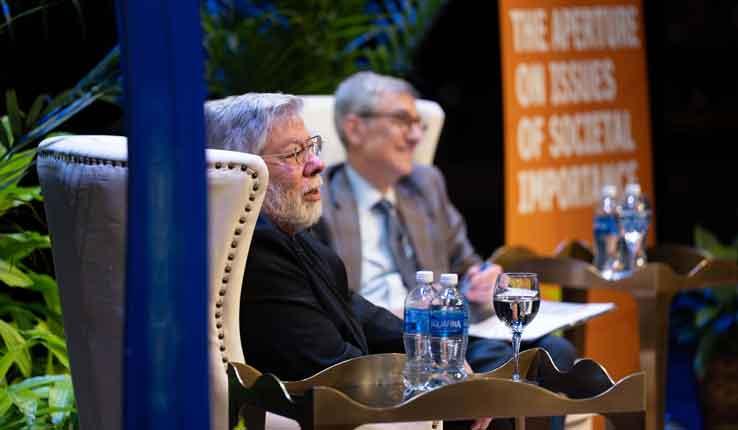
Two men seated on stage during a discussion, surrounded by plants and water bottles.

Steve Wozniak told Lehigh President Joseph J. Helble that he would like to see AI regulated with large language models citing where each piece of information presented is sourced from.

Prompted by a question from Helble, the conversation turned to Wozniak’s thoughts on where Apple is today. He said he’s not as excited about the company mainly because as an owner of their product, there’s little room to make a change that benefits the individual.

“When Apple first started, we built products that were going to give people a better life,” Wozniak said. “You could buy a computer, you could buy software, and you could run it, and it never changed. Nobody owned it. You didn't have to go through a cloud, somebody else owning you and making decisions that affected you. You were not subject to that. You were not trapped. It was a whole different world.”

Wozniak said the internet, which was great at first but later became more of a problem, ended that through cloud-based services and the social web.

He also said Apple has been a little slow when it comes to AI, which Helble used to segway into Wozniak’s thoughts on AI in general.

“AI doesn't really understand things or what they are,” Wozniak said. “It just analyzes.”

While Wozniak said AI can assist with tasks or help make decisions, it’s not intelligence.

“I've always been for the human over the technology,” Wozniak said. “As a human, you can solve things. That makes the human more important. If the technology is more important, the human has to learn all these different ways to do things to use the technology.”

Wozniak also agreed with Helble that using AI as a tool to enhance your work, collaborating with it, is a great way to use it.

“Humans are not getting displaced,” Wozniak said. “It just doesn't do the job fully enough. And look at all the hallucinations of the deep fakes.”

He also advocated for regulating AI by labeling exactly where large language models, such as ChatGPT, are getting the information they’re giving users. Whether it’s a page of a specific edition of a newspaper or an exact database, clicking on any part of the answer should yield the source of information, he said.

While the visit was Wozniak’s first to Bethlehem, he said he was impressed with the area and, having kids who were wrestlers, also gave a shoutout to Lehigh’s wrestling team for its notoriety.

‘We’re Starting Apple’

Prior to the fireside chat, Wozniak met with a handful of students for an invitation-only question-and-answer session, moderated by Provost Nathan Urban, lasting 50 minutes.

While some of the questions previewed what Wozniak addressed in the evening’s main event, such as his pranks and the 2013 movie “Jobs” (“Don't believe a thing in it,” he said), Wozniak discussed other topics, including never wanting to be management.

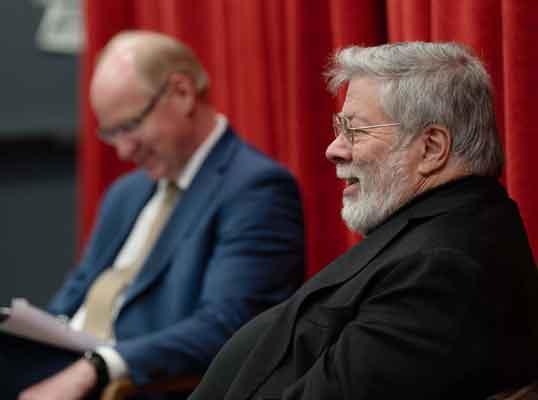
Two men seated on stage, one smiling with a beard and glasses, the other laughing in a blue suit.

Steve Wozniak, right, with Provost Nathan Urban during an invitation-only Q&A with Lehigh students.

Wozniak told students at age 18, which coincided with the height of Vietnam War protests, he decided he would be non-political and never vote. He didn’t want to take sides. He also strongly wanted to stay an engineer for life and at first said he turned down “big money” to do so. Jobs got friends and relatives of Wozniak to try and talk him into taking the money and finally one friend got through to him.

Wozniak told the students his friend said he could be an engineer, become a manager and get rich. Or, he could be an engineer, stay an engineer and get rich by being paid for the work he’s done.

“I changed my mind right then and called Steve Jobs and said, ‘We’re starting Apple.’”

Wozniak was commended for his passion and values by an international student studying accounting, who asked how his purpose may have changed over the years.

“It doesn’t change,” Wozniak replied.

Wozniak then told the students how after surviving a plane crash, he realized it was his last chance to finish his degree. While his name was famous, he said his face was not, so he went back to UC Berkeley using a fake name and his diploma reads “Rocky Raccoon Clark.”

He noted the value of education and described college as “incredible.”

“You have intellectual freedom, you have your time, time to use your intellectual freedom and learn more than they're just teaching in classes,” Wozniak said. “And you have physical freedom, you can go late at night working on a project just like you do all nighters once in a while. That's an important part of college and your development.”

Story by

Stephen Gross

Photography by

Christa Neu and Jordan Gruber