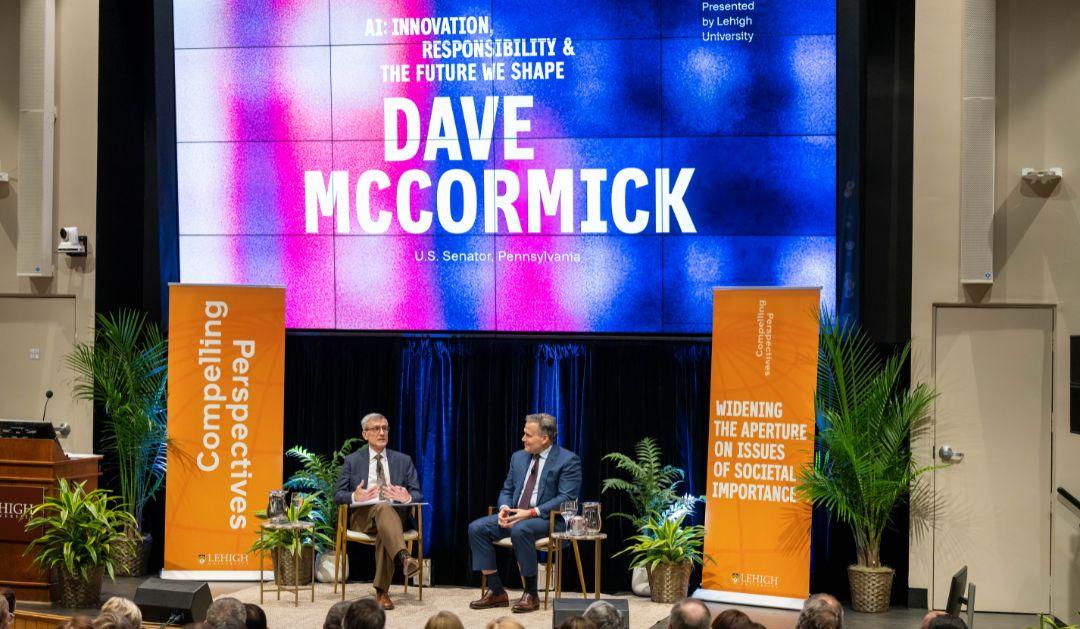
President Joseph J. Helble '82 and Senator Dave McCormick on stage at Compelling Perspectives.

Senator Dave McCormick Discusses AI Innovation at Compelling Perspectives

Getting your Trinity Audio player ready...

The senator spoke about Pennsylvania’s AI future, as well as the ethical and societal implications of AI.

Story by

Lauren Thein

Photography by

Christa Neu

Senator Dave McCormick (R-Pa.) shared a bold statement with the audience gathered for Lehigh’s Compelling Perspectives series: he believes society is facing the next Industrial Revolution in regard to AI, and it is the most important thing that will happen in the lifetimes of every person in the room.

McCormick was the second speaker in the 2025-26 series on Dec. 4. Compelling Perspectives aims to create a forum for fostering respectful discourse among differing perspectives on issues of critical and societal importance. The theme of the series this academic year is “AI: Innovation, Responsibility and the Future We Shape.”

The conversation with McCormick, exploring the role of the government, industry and higher education in shaping the future of AI and innovation, was led by President Joseph J. Helble ’82 and concluded with live questions from the audience.

Throughout his tenure in office, McCormick has been a vocal advocate for advancing AI and technology-driven growth across Pennsylvania.

In July 2025, McCormick hosted the inaugural Pennsylvania Energy and Innovation Summit at Carnegie Mellon University in Pittsburgh. The event convened global leaders in energy, technology, investment, labor and higher education to explore Pennsylvania’s potential to power the next wave of AI innovation.

At the summit, McCormick announced more than $90 billion in private-sector investments aimed at building the infrastructure needed to support AI development, energy generation and workforce advancement across Pennsylvania. These efforts are expected to create tens of thousands of jobs and strengthen Pennsylvania’s position as a hub for innovation.

The summit achieved the goal of serving as a catalyst for action, McCormick said.

McCormick explained why Pennsylvania is uniquely positioned to be an AI energy hub, noting that the state is the second largest energy producer in the nation, with a third of the state’s energy coming from nuclear power. He said Pennsylvania also boasts skilled workers needed to build energy infrastructure, universities that help foster innovation and a proximity to the Atlantic Ocean.

“We are closer to the end of the beginning than the beginning of the end of this journey,” McCormick said. “We are just right in the early stages. So our success for America and our success for Pennsylvania just depends now on what we do.”
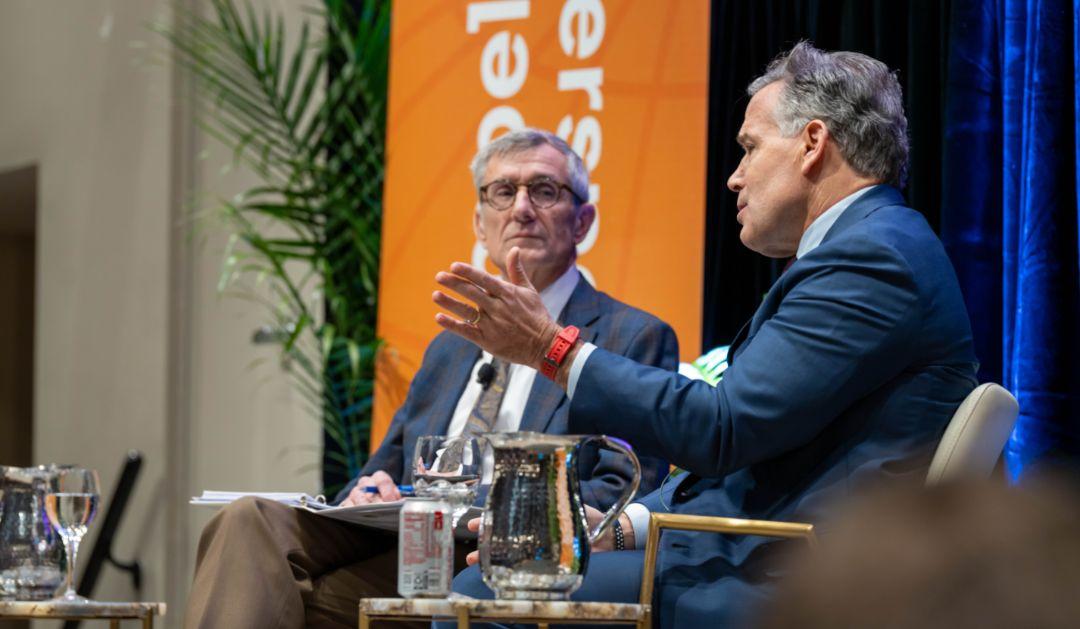

President Joseph J. Helble '82 and Senator Dave McCormick on stage at Compelling Perspectives.

Senator Dave McCormick was the second speaker in the 2025-26 series and participated in a discussion moderated by Lehigh President Joseph J. Helble ’82 on Dec. 4.


McCormick emphasized the importance of universities driving innovation and said they are central to success on this journey.

“I don’t think it’s an accident that the greatest pockets of innovation in our country are organized around universities,” McCormick said.

He also said innovation needs to happen across energy to keep up with the growing demand of AI.

“But you really almost can’t say the AI revolution without saying the energy revolution—they’re different sides of the same coin,” McCormick said. “You can’t have AI leadership without the energy leadership, and that’s one of the reasons that that innovation needs to happen across energy as well to meet this growing demand.”

McCormick spoke about the progress AI can bring to create opportunity, while also presenting uncertainties and questions about how it is going to affect society and culture.

“There’s lots of things we have to figure out, because moments of huge change are disruptive,” McCormick said.

McCormick noted he is worried about energy prices for consumers and potential job loss as a result of AI. He said an area of uncertainty is the question around ethics and guidelines for AI, and he believes it is the joint responsibility of the policymaking community, private sector and universities all playing a role in thinking about it.

“The thing that feels least fleshed out is the question around ethics and guidelines, and it’s a balancing act because on one hand, you want to keep this open-ended enough to allow innovation to take place,” McCormick said.

McCormick said the federal government is introducing legislation, as well as guidelines from the president and executive orders regarding AI. However, he thinks there is caution about overregulating and doing so too soon.

Helble inquired about McCormick’s focus on talent, technology and data in regard to the race for a global supremacy and addressing this in a bipartisan way as detailed in McCormick’s 2023 book, “Superpower in Peril: A Battle Plan to Renew America.”

“The reason I came down to those three, and they’re very much interdependent with one another, was that technology leadership and the pace of technology was changing so much that technology is sort of the foundation of everything,” McCormick said.

In terms of AI, progress in life sciences, next-generation mass manufacturing, curing diseases or military capability, underneath it all is technology prowess and leadership, and the pace of change is increasing every day, McCormick said.

President Joseph J. Helble '82 and Senator Dave McCormick on stage at Compelling Perspectives.

The conversation with McCormick, exploring the role of the government, industry and higher education in shaping the future of AI and innovation, concluded with live questions from the audience.

He said in order to remain the technology leader, America has to have talent and attract talent from around the world.

In regard to talent, Helble asked McCormick if it worries him that engineering and computer science bachelor’s degrees continue to grow in China as they continue to fall in the U.S., with the ratio of engineering and computer science bachelor’s degrees granted in China compared to the U.S. being about 9 to 1.

McCormick said he is deeply worried about the statistics Helble shared. He said it’s important to note that America’s percentage of that ratio include the brightest minds of the world in the best universities across the globe, but thinks the U.S. is at risk of losing that lead and special ability.

“We should ensure that we don’t lose a unique asset we have, which is we still are the place that most of the greatest people in the world want to come,” he said. “We’ve got to take advantage of that and become the place that that talent comes and manifests itself.”

McCormick also noted the importance of ensuring there’s funding in sciences to support a growing number of scientists, and giving talented people that come to the U.S. the opportunity to stay and build the next generation of great companies.

In terms of data, McCormick referred to it as “the new strategic currency.”

“It’s the underlying thing that one needs to drive innovation in the world of artificial intelligence,” McCormick said.

He said the final chapter of the book explains that unless you have leadership, none of those basic ingredients—talent, technology and data—can come together.

“It’s like any organization, you have to have a leadership to take it in the right direction,” McCormick said. “And these aren’t republican ideas or democratic ideas, these are leadership ideas. These are what it requires to make America successful.”

He said since arriving in the Senate, he’s introduced bipartisan legislation and takes a bipartisan approach in working with others to try to make progress.

“I am constantly reminded of the fact that while three and a half million people voted for me, I represent everybody, and so conducting oneself where you can get things done, stay true to your principles and recognize a lot of people you’re supporting and representing didn’t vote for you—that’s the opportunity but also the challenge.”

Early in the conversation, Helble inquired about McCormick’s upbringing in Pennsylvania and path to earning a Ph.D. in international relations from Princeton University.

Born in western Pennsylvania and raised in Bloomsburg, McCormick attended the United States Military Academy. A U.S. Army veteran, he went on to serve in the 82nd Airborne Division and was deployed to the Middle East during the First Gulf War, retiring with the rank of Captain. After earning his Ph.D., McCormick began his business career in Pittsburgh, where he rose to become CEO of FreeMarkets, a pioneering technology startup. He served as Under Secretary of the Treasury and Deputy National Security Advisor. Before running for the Pennsylvania Senate in 2022, McCormick was CEO of Bridgewater Associates, one of the world’s largest investment firms.

Compelling Perspectives debuted in 2023. In November, Arianna Huffington, founder and CEO of Thrive Global and founder of the Huffington Post, kicked off the academic year’s series with a discussion about the human side of AI and its role in personal health development and well-being.

Steve Wozniak, tech entrepreneur and co-founder of Apple, will be Lehigh’s third speaker on Jan. 29, 2026. His technology-informed discussion will focus on the evolving landscape of AI. The event is free and open to the public.

Story by

Lauren Thein

Photography by

Christa Neu