



From the rainforests of Washington state and Panama to the groves on Lehigh’s campus, Michelle Spicer ’12 M’14, assistant professor of Earth and environmental sciences, conducts research in these scenic living laboratories, perched among the trees to study plants in forest ecosystems from the ground soil to the leafy canopies.
Spicer studies community ecology, plant adaptations in forest ecosystems and what those adaptations reveal about climate change.
At the university’s fall Research Symposium, Spicer gave a lightning talk on her research that asks a central ecological question: how do plants and microbial communities respond when environmental conditions become hotter and drier?
Epiphytes and Climate Resilience
One branch of Spicer’s research focuses on epiphytes and specifically, tropical canopy plants. Epiphytes—plants like orchids, bromeliads and aroids—grow on other plants, spending a part of their life cycle not rooted in the ground soil.
These canopy plants have a unique, fundamental sensitivity to temperature and moisture, making them powerful indicators of how forest ecosystems respond to a warming world.
“Canopy plants can tell us a lot about how our world is changing, how plants are responding to those changes, and how biodiversity may shift in the future,” Spicer said.
Tropical rainforests create steep environmental gradients. Less than 1% of light gets down to the understory, but up high in the canopy, plants are exposed to extremely bright light, hotter temperatures and drier air. Spicer uses her research as a model system for organisms that are being pushed by climate change into hotter environments.
Studying Climate Change in Forest Canopies
Spicer currently leads two epiphyte-focused field projects spanning diverse ecosystems, from the temperate Hoh Rain Forest in Washington state to tropical forests in Panama.
In Washington’s temperate environment and Panama’s tropical environment, her team compares how epiphyte communities assemble and respond to disturbance depending on whether they grow in shaded understories or high canopy environments. This summer, Spicer will return to Washington with an undergraduate researcher and technician to survey long-term field plots.
Her newest project, based in Panama and supported by a National Science Foundation grant, expands the research below the plant surface. Working collaboratively with scientists Jane Lucas and Evan Gora of the Cary Institute of Ecosystem Studies, Spicer is investigating how soil microbes change across the same vertical forest gradient.
The team conducts field experiments in Santa Fe National Park in Panama, where Spicer has worked for nearly a decade, as well as laboratory studies at the Smithsonian Tropical Research Institute. Early findings are showing some microbes that thrive in the shady understory often vanish in the sun-soaked canopy, replaced by entirely different communities.
What Forest Ecosystems Reveal About Climate Change
Preliminary findings show how these plant communities respond to disturbance. Spicer’s research included transplanting clusters of epiphytes between different canopy layers, tracking how they adapt when exposed to new conditions.
The results suggest that some species can recover quickly after disruption, while others, especially those in hotter, drier canopy zones, struggle to rebound. As climate conditions shift worldwide, these results suggest that certain plant communities may face increasing difficulty recovering from climate change.
Global Ecology, Local Impact at Lehigh
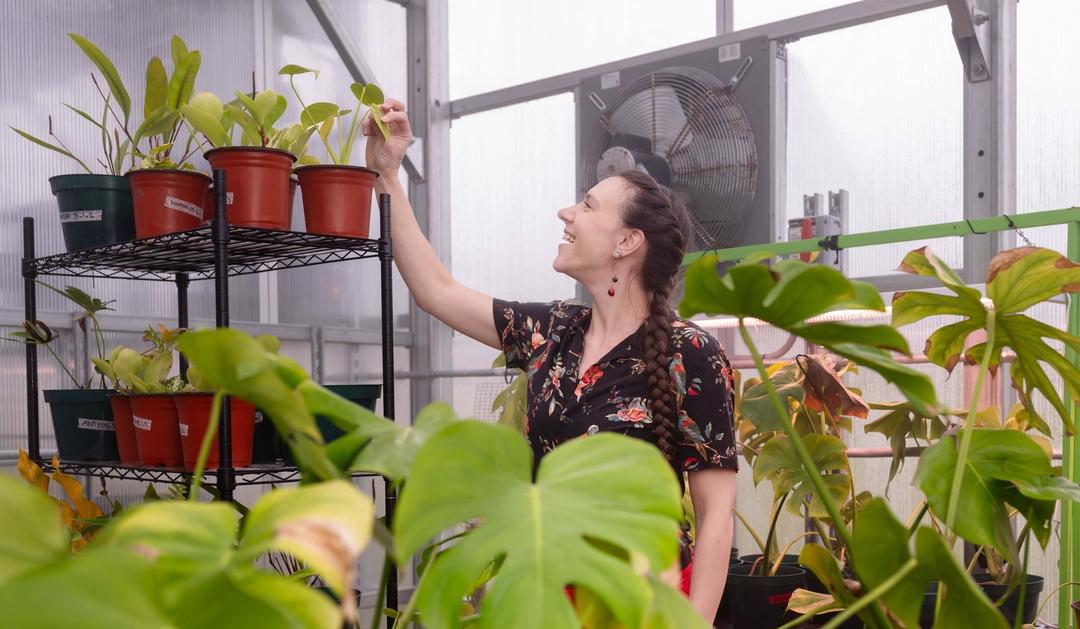
In her greenhouse on Lehigh’s Mountaintop campus, now open for a full year, Spicer facilitates impressive student-driven research experiments. Her team cultivates miniature versions of these tropical systems, nurturing epiphytes under controlled conditions that mimic the canopy’s shifting light and moisture.
The work connects all levels of researchers directly to global ecological questions and, in Spicer’s view, to the urgency of climate change.
“I think it’s really important to have a branch of my research that is really accessible. Right here on campus we’re also looking at regional challenges to forest diversity,” Spicer said. “What's going on right here in Pennsylvania has an incredible impact.”
Mentorship and Community in Ecology
While studying ecological communities in forests, Spicer has also built a lively community of ecologists at Lehigh. As both an undergraduate and graduate alumna of Lehigh, Spicer understands the value of mentorship. She was taught by professor Robert Booth, the current department Chair of Earth and environmental sciences, and teaches alongside him today.
Spicer, Booth and John Paul Balmonte, assistant professor of Earth and environmental sciences, are the three ecologists in the department. Each works in different systems and different time scales, yet come together in all-ecology meetings to share insights and strengthen community with their students.
“There are these overarching, core questions that are large in ecology,” Spicer said. “It feels like a community where not only do we get along, but share scientific passion as well.”