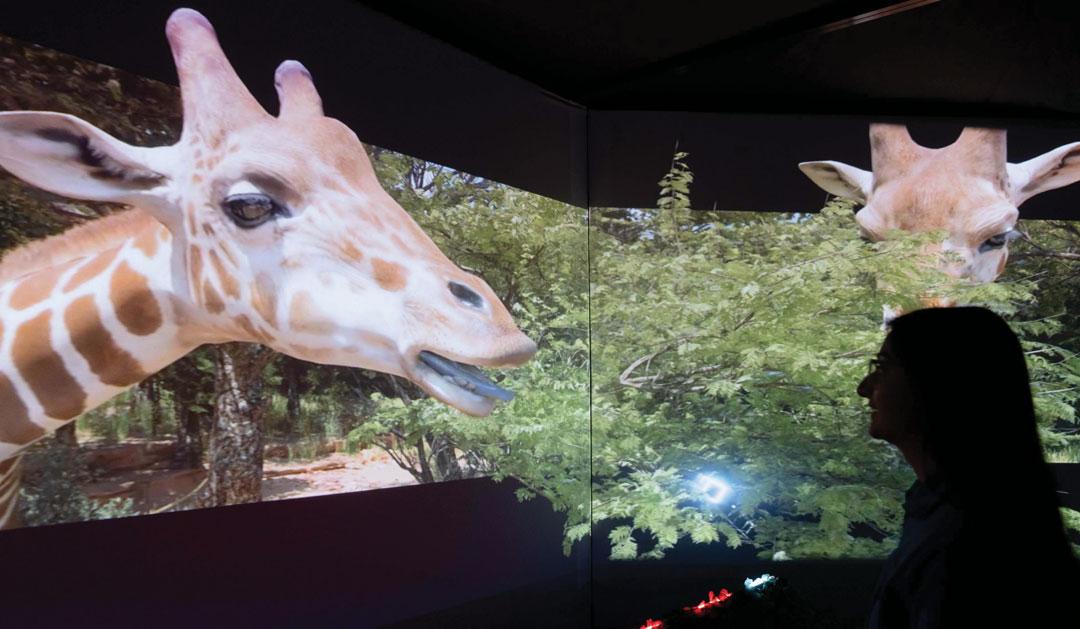
A person observes a large projected image of a giraffe surrounded by greenery.

Hologram Zoo Brings Animals Alive with Light

Getting your Trinity Audio player ready...

Manpreet Patel MBA’25 opened what she calls an ‘edutainment center,’ the second of its kind in the nation, earlier this summer.

Story by

Stephen Gross

Photography by

Christa Neu

While taking a global business European perspective class at Lehigh, Manpreet Patel MBA’25 began working on the idea of a hologram zoo. Born out of her son’s love of nature, her experience as a business owner and the idea of a cruelty-free approach to aquariums and zoos, the grand opening of her venture took place July 18, 2025 in Easton, PA.

How did you come up with the idea for a hologram zoo?
My son really enjoys everything about nature and I've always wanted to do something that's within the educational sector, but I have a background in business. Having been in a corporate role and with my husband and I having two retail locations, I wanted to do something more. After extensive research, I found there's technology where holograms could be brought to the mainstream audience. My son really enjoys his jungle-themed room, so it was something that caught my eye and my interest. … Technology as well as wildlife, both have great meaning to my family, along with being vegetarian and supporting brands that are cruelty-free. This is also a cruelty-free approach to aquariums and zoos. Obviously, we can't compete with nature, but it's a good complement where you can interact with the holograms. No animals are harmed. It's all year-round, appropriate for all ages and there is an entertainment factor to it.

When did you get the idea?

I wanted to do something within the STEM learning space. I knew Da Vinci Science Center was already doing a really good job catering to that audience. I also wanted to do something that was completely different that hasn't been done already, especially in the Lehigh Valley area. I was taking my global business European perspective class in August 2024. That's actually when I first carved out the time to work on this business idea in terms of the strategic plan, the marketing plan, doing a little bit more of a deep dive, understanding the demographics, understanding the business plan, writing that out.

What age is your target demographic?

Five and up is our ideal age for the Hologram Zoo because we give everybody a pair of specialized glasses to wear. Children under four have a hard time keeping the glasses on the whole time, so they're not really able to experience the show to the fullest. All of our shows do have an element of surprise where animals will pop out at you and the younger children feel it's very lifelike, so they're not expecting the animals to come so close, and they do. So that may make them a little shocked. It also does get a little loud in there with the animals.

What exactly is a hologram zoo?

We offer 3D holographic experiences. I like to call it an ‘edutainment’ center. It's educational and entertaining at the same time. All the animals are made of projected laser light, but they look, act and sound very realistic. Our zoo shows change quarterly, with seasonal shows offered during specific times of the year, but we can take you to different parts of the world to see animals that you may otherwise not have a chance to see. For example, going on an African safari or going back in time to visit the dinosaurs up until the Cretaceous Period. We also have interactive and immersive group experiences where we have a specialized room where you play mini-games like an underwater adventure, which is our most popular experience for the rooms. You go down in a submarine; you learn about bioluminescence. You repair the submarine because it cracks due to pressure. You help baby sea turtles get to the ocean, and more. It's all indoors, so regardless of the weather, you can see all the animals in their normal environments, but you get to do it all through holograms.

Why holograms and not traditional screens or virtual reality headsets?

Virtual reality, based on my research, is not suitable for everyone. Some people find that it makes them dizzy or nauseous and it is a bulky headset. Our main target audience is school-aged children, five to 14, but we found the elderly also really enjoy the experiences. But for that target audience, the normal VR or AR glasses would be uncomfortable.

How long can people expect to spend at the Hologram Zoo?

On average, when families or groups come in, they spend around two hours here. Most families do the zoo show plus the room show, which takes a little over an hour to complete. Each zoo show also comes with a complimentary group photo studio session, where guests take show-themed photos and videos that are instantly downloadable via QR code. Then, they get a free projectogram gift to take home. We also have a variety of merchandise to explore such as animal and dinosaur plush toys that you will see in the shows.
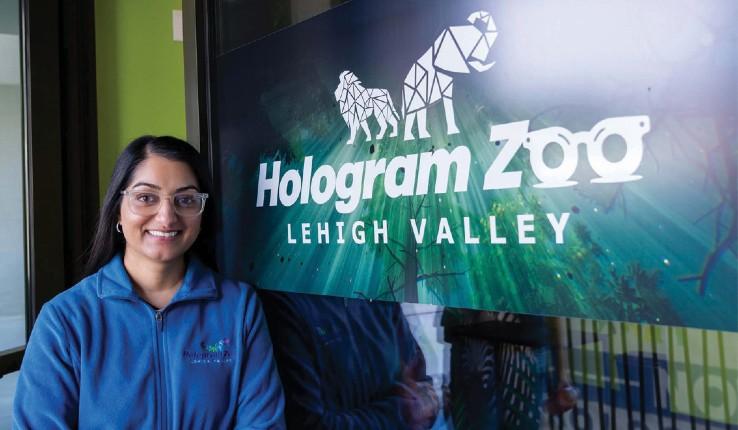

A woman smiles beside a sign for Hologram Zoo, Lehigh Valley, featuring animal silhouettes.

Manpreet Patel MBA’25 has opened Hologram Zoo, which she calls an ‘edutainment’ center, in Easton, PA.

Do the animals react to the visitors?

It is pre-programmed. The way that it works is there is an LED light strip on the fence of the zoo tunnel, animal enclosures and skyroof—you don't want to walk outside of the light strip. The way the show is timed and created is it's walking you through the content, but based on where you're standing, the dinosaur is going to pop out and the commentary will say, ‘Reach out and touch the dinosaur,’ or ‘Reach out and pat the giraffe.’ The animal or dinosaur actually looks like it's right in front of you because you're standing at that particular point of the zoo unit. Based on where you're standing and how it's timed, the animals are going to jump right out at you because you're standing right in front of them at that particular moment.

How difficult is it to recreate the sounds and movements of animals through holograms?

It requires a lot of research. We work with a company called Axiom Holographics, which has been making this type of technology for years. Although, this is the first time they have created educational, mainstream content like the hologram zoo experiences. We purchased the technology from Axiom and then opened our center. Then, in terms of creating further content, that's all coding and development. We license the content from them. … But they work closely with educators as well to make sure that the animals do look accurate and that the commentary is correct, and that they are depicting the environments and everything as closely to the actual way that it is in nature.

What types of shows do you have?

We offer zoo shows such as Africa, Australia and dinosaurs with shows changing quarterly, as well as seasonal shows such as Halloween and Christmas offered during those times of year. The space show, which is brand new, began in January and will run through March 31. We also have room shows, which are immersive group experiences where up to five people can choose to experience a holographic aquarium, dinosaur adventure, HoloSports or a holographic monster escape room.

How common is a hologram zoo?

We're the first in the Northeast and second in the U.S. I've had a lot of people contacting me because they also want to open a holographic center like ours. There's one in Austin, TX, and another that just opened in Niagara Falls, NY. It's becoming popular because people are seeing that this is the direction that entertainment is going.

You came up with the idea for this in one of your classes at Lehigh. What else here helped you in this venture?

I took entrepreneurship and innovation with Joshua Ehrig, [senior professor of practice]. It was a winter class that really helped me broaden my perspective of what types of businesses are out there. We discussed if you see a need, find a way to fill that need. That's how your business is going to be successful. Or identifying a problem and trying to find a solution for it. That got me brainstorming a little more to figure out what I wanted to do for my next business venture. The future of marketing course with Siva Sivakumar, [Arthur Tauck Chair and a professor of marketing], helped me create my marketing plan and I learned how to incorporate AI tools to generate marketing materials where I received genuine feedback from my professor and peers allowing me to make appropriate changes. I also took a negotiation class in spring with Liuba Belkin, [associate professor and the director of the management program at the College of Business], and I was in the middle of negotiating the space when I was taking that class. What stood out to me was her saying, ‘Don’t worry too much about the numbers,’ because I was so fixated on getting the space because four to five other clients were also looking at it, plus negotiating the rate and terms. She said, ‘If you are really passionate about it, if you know what you want, and you go in there, a lot of it has to do with how you present yourself, the confidence that you have and being prepared.’ … It prepared me well for this large-scale venture. I don't think I would have went for it, I wouldn't have had the confidence if I hadn't done my MBA. My professors at Lehigh helped me greatly, both my advisors, Megan [Van Voorhis] and then Marissa [Winter], really supported me.

You got into retail before this. What kind of retail?

I have two convenience stores, one in Allentown and one in Coopersburg. My husband is managing the Allentown store, I'm managing the Hologram Zoo Lehigh Valley and I have an amazing staff. Then the Coopersburg store, I manage it through team members, so everything is pretty much streamlined although initially it wasn't.

Have you always dreamed of starting your own business?

During the pandemic, seeing all the different changes, all that uncertainty and instability, that's really what sparked my journey. I mean, growing up, I always wanted to have my own business. I wasn't thinking large-scale initially, but once I joined the MBA program, I felt my skills would be better utilized in directly owning a business versus supporting a business in a corporate capacity.

Have you thought about the future at all?

Until you have six months to a year under your belt, it is difficult to invest in anything else, but I have plans to hopefully expand to a larger location or open more locations. Right now I have 6,000 square feet, where we've used every possible space, and still, I wasn't able to add everything that I wanted to add for this experience. I would like to add other advanced technology that is educational and appropriate for all ages. We offer field trips, group trips, birthday parties and private events and we want to offer guests the best technology, experience and customer service. And we’ve already been named a BusinessRate BEST of 2025 Easton Award Winner in the Education Center category, which would not have been possible without my family, team, customers and all the support I have received along the way.

Story by

Stephen Gross

Photography by

Christa Neu