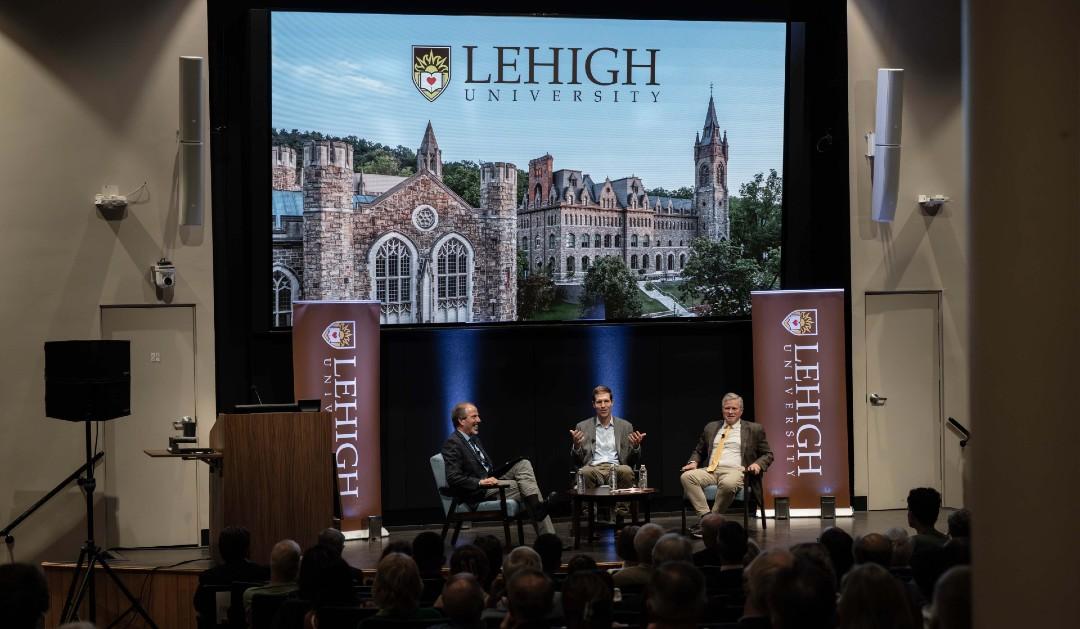
Photograph of three men on stage during a Lehigh University panel discussion.

Chris Borick (left), professor of political science and a nationally recognized political pollster, moderated a conversation between former U.S. Representatives from Pennsylvania Conor Lamb (center) and Charlie Dent M’93 (right).

Former U.S. Representatives Conor Lamb, Charlie Dent M’93 Discuss Democracy, Elections While Showcasing Bipartisan Dialogue

Getting your Trinity Audio player ready...

Working with the Carter Center, the co-leads for the Pennsylvania Alliance for Civic Trust (PACT) held their first public event Monday night in Packard Laboratory.

Story by

Stephen Gross

Photography by

Christa Neu

Conor Lamb was in high school when the Supreme Court helped decide the 2000 United States presidential election.

The former U.S. Representative from Pennsylvania said Democrats were disappointed by the outcome, some maybe even outraged. With the events that followed over the next eight years, he heard people say, “if only that election had gone differently...” But violence was never a thought.

“I don't remember a single person ever talking about the idea that violence would have been a way to address that situation,” Lamb said. “It just wasn't at all in the ether for us.”

Today, Lamb said, things are different. A growing number of the population under 30 years old has told pollsters violence against one’s political opponents is justified or sometimes necessary. It’s not just polls, either, as Lamb cited numerous events that back that data such as the Jan. 6 U.S. Capitol attack and assassination attempts on the sitting president and Pennsylvania governor in the state within less than a year of each other.

“That was really a minority view in my lifetime,” Lamb said.

That is part of the reason why Lamb, along with another former U.S. Representative from Pennsylvania, Charlie Dent M’93, has teamed up with the Carter Center, which was founded in 1982 by former U.S. President Jimmy Carter and works to resolve conflict, advance democracy, protect human rights and prevent disease, to form the Pennsylvania Alliance for Civic Trust (PACT).
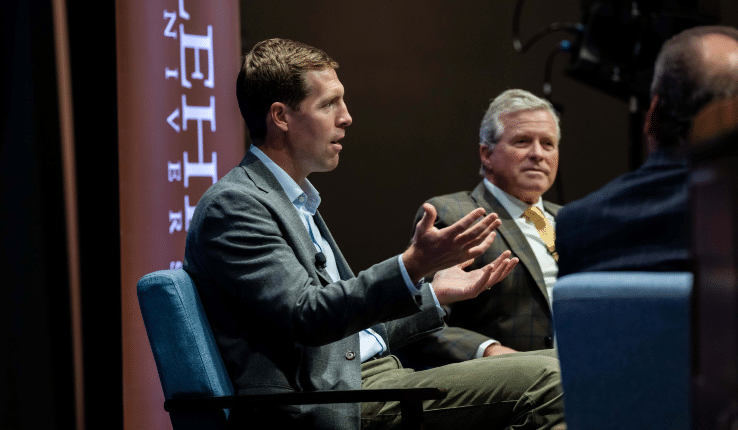
Photograph of a man in a suit gesturing while speaking during a discussion.

Chris Borick, professor of political science and a nationally recognized political pollster, moderated the Pennsylvania Alliance for Civic Trust (PACT) event.

Lamb, a Democrat, and Dent, a Republican, are the co-leads for PACT, which is focusing on the resilience of American democracy by building civic trust, highlighting best practices for the election process and establishing constructive, bipartisan dialogue. The two showcased that on Oct. 26 in their first Pennsylvania appearance, participating in a 40-minute conversation in Packard Laboratory, moderated by Chris Borick, professor of political science and a nationally recognized political pollster. The final 20 minutes were reserved for an audience Q&A, which generated a handful of questions about the current election cycle as well as recurring election-related topics, such as voter ID laws and money in politics.

Despite representing opposite political parties, the two found common ground throughout much of the discussion. One of their few policy disagreements during the evening came in the last audience question of the night from Benjamin Katz ’28, who asked if more states should adopt voter ID laws, since IDs are required to buy alcohol, drive, fly and other activities.

Dent said he has always supported voter ID, although he opposes the currently proposed SAVE Act, which includes proving citizenship. A driver’s license doesn’t prove status, he said, and while a passport does, requiring one is unrealistic since many lack one. He suggested a national digital ID to make things easier for everyone.

Lamb countered that unlike driving or other regulated activities, voting is a fundamental constitutional right. “Anytime that the government is going to then condition your exercise on that right on something such as showing ID, they had better have a really good reason and they better make it no harder than is absolutely necessary for you to exercise that right.”

Acquiring an ID presents financial and logistical hurdles for some Americans, Lamb said. “It may be a small number, it may not even be decisive in some elections. But those people are Americans too. They have constitutional rights too.”

Dent clarified that he wouldn’t limit photo ID to driver’s licenses, and school IDs should be acceptable. “I don't think it's unreasonable that we should verify who we say we are. And many states have already had this requirement. I don't think they found it to be an unreasonable burden for the most part.”

President Joseph J. Helble ’82, who introduced the panel and provided closing remarks, acknowledged the slight difference in opinion and how it was handled.

“There might have even been a little bit of a policy disagreement at the end,” Helble said, “but conversation that was done in a way that was thoughtful, civic, civil and focused on the important issues in front of us.”

Photograph of a man gesturing and speaking at a Lehigh University panel discussion.

Former U.S Representative Conor Lamb (left) speaks during the first public event for Pennsylvania Alliance for Civic Trust (PACT). Charlie Dent M’93 (right), also a former U.S. Representative, is a PACT co-lead with Lamb.
Throughout the rest of the program, Lamb and Dent both shared personal anecdotes about the election process, including how votes are counted and who is counting the votes, as a way to reinforce confidence in the system. Dent said errors happen, but are usually caught during canvassing before votes are certified and because the process is transparent, his team was even able to spot an innocent mistake in recording a vote total at one precinct and alert officials, who quickly confirmed the error and corrected it.

Dent added that poll workers earn very little pay and simply are doing their civic duty.

“I worry about people getting into positions in some states where you hear about people running for election boards who have predetermined outcomes in vying for elections,” Dent said. “And that's dangerous. Your job is to basically be a fair arbitrator of the election, not to try to put your finger on the scale.”

Lamb agreed and mentioned one of his elections as evidence the poll workers don’t care about the outcome, just that the process gets done and correctly. One year, he was winning by 95 votes with around 220,000 total cast. Late in the evening, when news organizations started calling election offices to see about outstanding absentee and military ballots in the rural counties, they found they had left for the day.

“They had all gone home to go to sleep at the end of their workday,” Lamb said, “and their attitude was, ‘Well, we're just going to count them in the morning. It's not going to change what the result is.’ Which obviously I was kind of frustrated by and people started making calls and literally got them out of bed to come back and count them … but they were disinterested as to the outcome. They really did not care who won and who lost that race. It was their job to just open the envelopes and count it. And that always stuck with me.”

Borick also asked the former U.S. representatives why they’re devoting time to this initiative when they’re already both busy with full-time careers and their own families.

Lamb cited his young children—ages 5, 3 and 1—as part of his motivation.

“You find yourself wanting to teach them in accordance with your values and I want them to think of the United States as being a place where the best argument wins,” Lamb said. “Where it's not just might makes right but where we live according to some higher ideals and purposes.”

While he has been able to work on specific policies throughout his career, he said he believes the system is struggling with fundamental issues more basic than policy preferences. He’s hoping to get back to where those fundamental issues no longer need to be the focus.

Dent expressed similar views to Lamb.

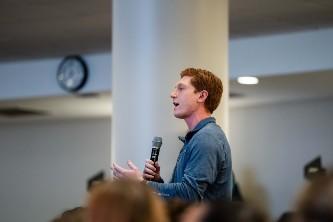
Photograph of a red-haired man speaking into a microphone during a presentation.

Benjamin Katz ’28 participated in the audience Q&A and asked if more states should adopt voter ID laws, since IDs are required to buy alcohol, drive, fly and other activities.

“Our democracy is struggling right now,” Dent said. “It's not as healthy as it needs to be. It needs to be better and it can be better. And I'll just do my little piece to help hopefully make it better. And people around the world look to us at the United States as the exemplar, as a great example of what democracy is supposed to be. Well they're not really saying that right now, unfortunately. Other countries are pretty good at this democracy business too and we need to do better.”

While the audience was a balanced mix of students, staff, alumni and community members, the last question Borick asked Lamb and Dent to tell America’s next generation of leaders in attendance one area their talents would best serve the democratic system in the United States.

Dent responded first, saying “there’s a role for everybody,” regardless of their interests or discipline. He listed examples such as the National Institutes of Health for those in the life sciences and the Environmental Protection Agency for those in civil engineering.

“If you're thinking about a career path, I've met a lot of people in the financial services industry who've done extremely well, who spent time in treasury during the troubled asset program, for example,” Dent said. “They were on the regulatory side and learned a lot and they were able to transfer those skills into those government skills in the private sector and vice versa. … You don't have to just run for office. You can, but you don't have to run for office. You can do all sorts of things to serve your country.”

Lamb advised the students in attendance to ignore the forces conspiring to convince people they can’t have much influence on the government. He relayed a story of a recent college graduate running a very successful state representative campaign as campaign manager in his old district in a district that has voted against that candidate’s party by five points in the last election.

“She is, from what I can tell, running the best campaign that this guy has ever had,” Lamb said. “They just crossed over their 30,000th door knocked for the district, which in a state house district is about half of the doors in the entire district. And they had already banked more mail-in votes by Democrats this term than they had had in all of 2024, all the mail-in votes. And this was two weeks before the election. She did that. And in five months out of college, she's pretty much single-handedly taking the district off the map.”

Story by

Stephen Gross

Photography by

Christa Neu